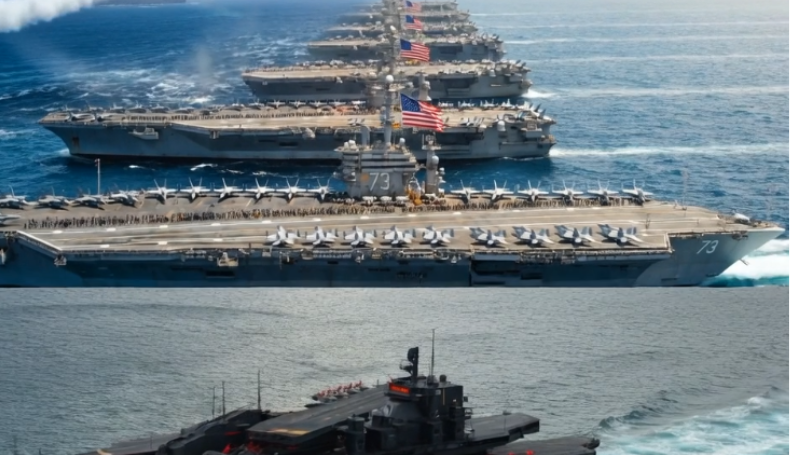
The USS Gerald R. Ford is a technological leap forward in nearly every respect. Unlike older carriers, it uses the Electromagnetic Aircraft Launch System (EMALS) instead of steam catapults, allowing aircraft to launch more quickly and efficiently. This means the ship can deploy more planes in less time, significantly increasing its combat effectiveness. It also produces far more electrical power than previous carriers, enabling it to support advanced radar systems and future weapons technologies. As a result, it stands as a powerful symbol of American innovation and military capability.
However, the true strength of a carrier lies not in the ship alone but in its role within a Carrier Strike Group (CSG). These groups include destroyers, submarines, and support vessels working together as a unified force. This layered system provides protection against threats from the air, sea, and below the surface, while also allowing the group to project power over long distances. For decades, such formations have been central to the United States Navy’s ability to respond rapidly to global crises.
Rather than matching this approach directly, China has focused on countering it. Its strategy centers on developing long-range weapons designed to neutralize carriers before they can influence a conflict. Among the most notable are anti-ship ballistic missiles like the DF-21D, often referred to as “carrier killers.” These weapons are capable of striking moving ships from great distances, reducing the need for direct naval confrontation and shifting the balance toward long-range precision warfare.
An even more significant challenge comes from hypersonic missiles, which travel at speeds greater than Mach 5. These weapons are extremely difficult to detect and intercept, leaving little time for defensive systems to respond. As China continues to invest in this technology, the threat to large, high-value targets like aircraft carriers becomes increasingly serious.
In response, the United States Navy has developed layered defense systems to protect its carrier groups. These include advanced radar, interceptor missiles, and electronic warfare capabilities designed to stop incoming threats at multiple stages. While effective, these defenses are constantly being tested by new and more sophisticated weapons.
Looking ahead, the future of naval warfare will likely be defined by this ongoing competition. Aircraft carriers will remain important, but their role may evolve as new technologies emerge. The balance of power at sea will depend not only on strength, but on innovation, adaptability, and the ability to respond to rapidly changing threats.