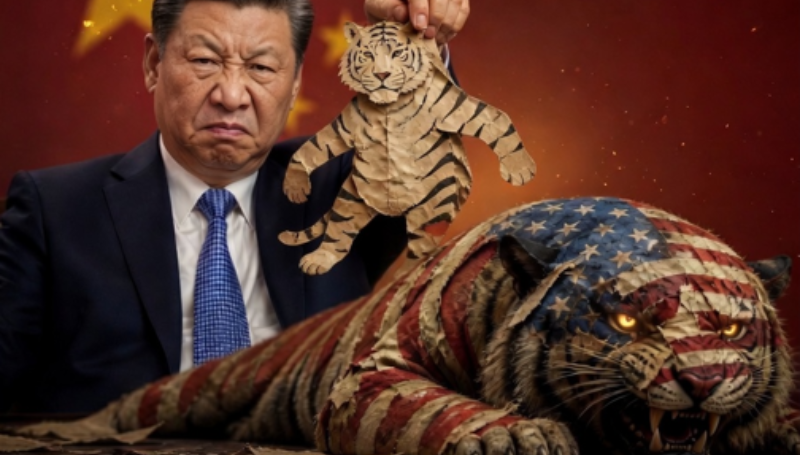
The phrase “paper tiger” carries a long history as a political insult, suggesting that a country or power appears strong on the surface but is actually weak. It was famously used during the Cold War and still appears in modern geopolitical rhetoric. When Chinese officials or state-affiliated voices apply this label to the United States, the intention is to challenge America’s global image, questioning its strength, resolve, or influence.
However, the idea that all Americans are “furious” about such a statement is an overgeneralization. Reactions within the United States tend to vary widely depending on political views, media coverage, and the broader context in which the comment is made. Some individuals interpret the remark as provocative or disrespectful, especially given ongoing tensions related to trade disputes, military positioning, and competition for global leadership. For these groups, the phrase can feel like a direct challenge to national pride and authority.
On the other hand, many people see this kind of language as routine in international relations. Political rhetoric between major powers is often sharp and symbolic, designed more to send a message than to provoke genuine outrage. In this sense, the “paper tiger” comment may be viewed as part of a larger pattern of strategic communication rather than a serious or immediate threat.
Ultimately, such statements are often aimed at multiple audiences. They can reinforce domestic confidence within China, signal determination to allies, and test the reactions of rivals. While the phrase may attract attention and spark debate, it does not necessarily reflect a unified or intense emotional response across the entire American population.