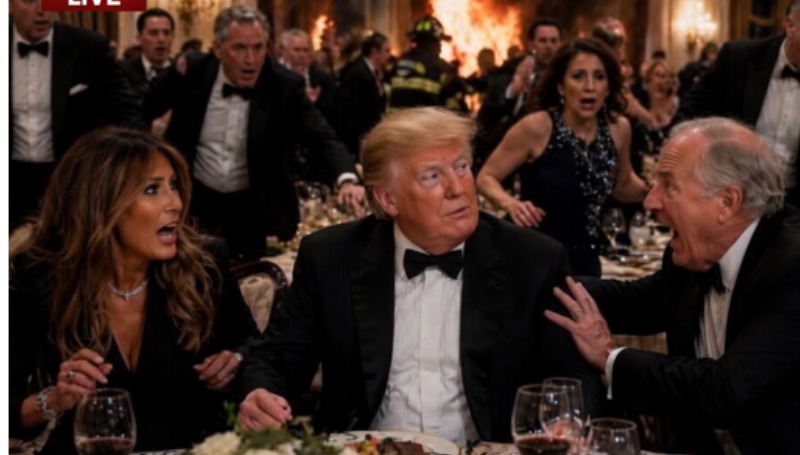
A viral post recently spread across social media after former CIA analyst Larry Johnson suggested that a chaotic incident involving Donald Trump may have appeared staged. The claim quickly gained traction online, largely driven by short video clips that showed people reacting with panic while Trump himself appeared calm and composed. The contrast in behavior became the focal point of widespread discussion and speculation across multiple platforms.
As the footage circulated, users began offering competing interpretations. Some argued that the reactions in the scene seemed unusually coordinated or inconsistent, raising questions about whether the moment was authentic or deliberately managed. Others strongly rejected this interpretation, emphasizing that isolated clips can easily distort reality when removed from their broader context.
Media analysts and communication experts frequently caution that viral videos rarely capture the full sequence of events. In fast-developing situations, individuals may respond differently based on what they can see, hear, or understand at a given moment. Factors such as camera angle, timing delays, and off-screen activity can significantly alter how a scene appears to viewers who are only seeing a fragment of what actually occurred.
In this case, there is currently no verified evidence supporting claims that the incident was staged or orchestrated. Despite the speculation circulating online, no credible investigative reporting or official confirmation has substantiated the idea that the reactions or circumstances were artificially produced. As a result, most informed commentary has focused on the risks of interpreting incomplete visual material rather than endorsing any particular theory.
Experts in digital media literacy also highlight how quickly narratives can form around emotionally charged or ambiguous clips. Social media platforms tend to amplify striking or dramatic content, often before context or verification is available. This can lead to widespread assumptions being formed on the basis of partial information, even when fuller details might tell a different story.
The situation reflects a broader challenge in the modern information environment, where short-form videos can shape public perception within minutes. Once a particular interpretation gains momentum online, it can spread rapidly and become difficult to correct, even if later evidence contradicts it.
At present, the discussion remains speculative rather than factual. While online debate continues regarding the nature of the incident, there is no substantiated proof confirming that it was staged. Analysts continue to urge caution, emphasizing the importance of relying on verified sources, complete footage, and established reporting before drawing conclusions about high-profile or politically sensitive events.