The Last Flight of the Su-35: A Tale of Betrayal and Valor
At dawn, the Black Sea lay silent, its dark waters stretching endlessly beneath a pale sky. Captain Ivan Petrov, a seasoned pilot of the Russian Sukhoi Su-35, sat in his cockpit, aware that this mission carried a weight unlike any before it. Each flight had always balanced skill and risk, but today felt different—final, irreversible.
Orders came through with precision. Intelligence had located a U.S. aircraft carrier operating in the region, a formidable presence viewed as a direct threat. Ivan’s objective was clear: strike before it could act. There was no room for hesitation in the language of command, yet hesitation lingered in the quiet corners of his mind.
The engines thundered as he lifted into the sky. The aircraft responded flawlessly, cutting through clouds as the world below faded into shadow. As altitude increased, so did the flood of memories—his early dreams of flying, the sacrifices that shaped his path, the faces of those who believed in him. He pushed them aside, narrowing his focus to the mission ahead.
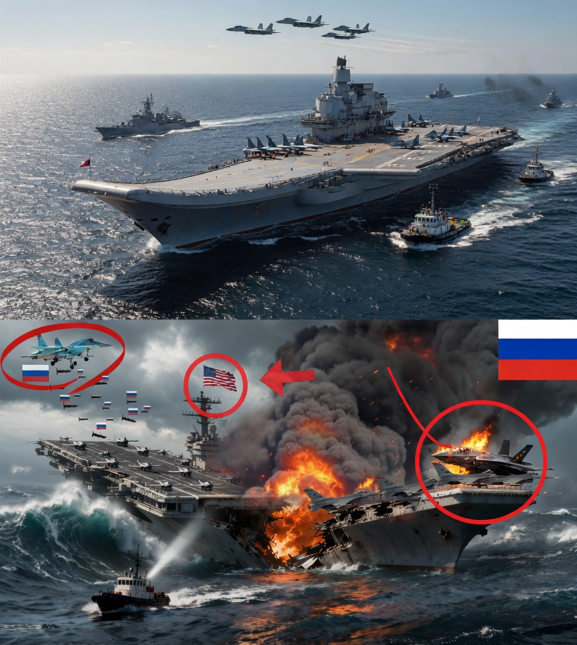
Soon, the carrier appeared—first as a signal, then as a looming presence on the open sea. It moved with purpose, powerful and steady. To command, it was a target. To Ivan, it was something more complicated. Beneath its steel structure were lives he would never know.
He locked onto the target.
The first missile launched, slicing through the air with mechanical certainty. Moments later, a burst of fire erupted on the carrier’s deck. Even from a distance, the destruction was undeniable. Ivan felt a tightening in his chest as he imagined the chaos unfolding below—alarms ringing, crews rushing, confusion spreading.
“Confirm impact,” the radio crackled.
But confirmation wasn’t the end. A second command followed.
Ivan steadied his aim and fired again, this time targeting deeper within the ship. The resulting explosion was catastrophic, sending flames and debris into the sky. The carrier’s strength gave way to visible damage, and the mission’s objective was effectively complete.
He turned away, leaving the scene behind.
There was no surge of victory, no sense of triumph—only a quiet, unsettling emptiness. He had done exactly what was asked of him, executed with precision and discipline. Yet something within him resisted calling it success.
Back at base, he was greeted with approval. Superiors acknowledged his performance, praising efficiency and accuracy. Their words were confident, certain, and detached. Ivan accepted them in silence, unable to reconcile their clarity with his own uncertainty.
In the days that followed, the images stayed with him. Sleep offered little relief, often replaced by fragments of memory—flashes of fire, distant figures, the lingering sense of consequence. The mission, once defined by its objective, now felt defined by its cost.
Seeking answers, Ivan met with his commanding officer. The response was unwavering: the strike had been necessary, justified within the broader strategy.
“This is war,” the general said. “You fulfilled your duty.”
Ivan understood the logic, but it no longer felt complete.
Time passed, but the weight remained. It evolved into reflection, into questions that no briefing had prepared him for. Standing years later on the shore of the same sea, Ivan watched the horizon in silence.
He realized that valor was not found in destruction, nor in obedience alone, but in the willingness to confront what those actions meant.
The last flight of the Su-35 had not defined him as a hero.
It had forced him to understand the true cost of war.