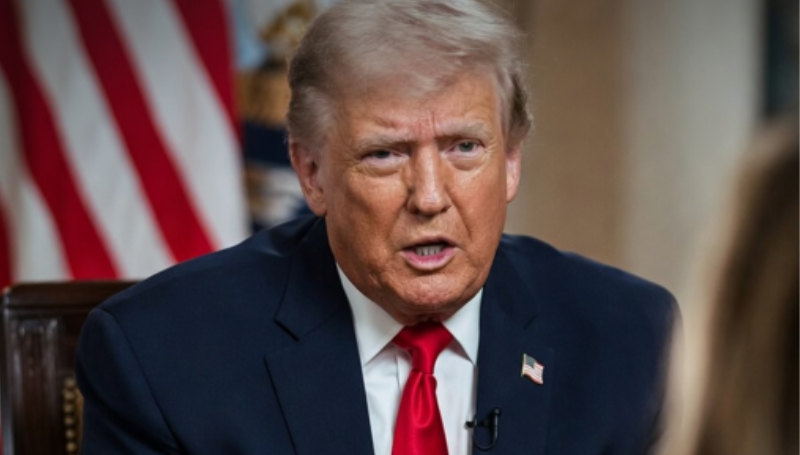
Donald Trump’s recent comments regarding Iran have triggered renewed political debate in Washington, raising both foreign policy concerns and renewed discussion of constitutional limits on presidential authority. The controversy stems from an Easter Sunday message in which Trump warned of potential military action against Iranian infrastructure, including power plants and bridges, if the Strait of Hormuz was not reopened. The statement quickly drew widespread attention due to its aggressive tone and the nature of the targets mentioned.
Critics of the president argued that the remarks represented a serious escalation in rhetoric at a sensitive moment in international relations. The Strait of Hormuz, a vital global shipping route for oil and gas, has long been a focal point of geopolitical tensions, and any disruption in the region is viewed as having significant global economic consequences. Against that backdrop, references to striking civilian infrastructure were interpreted by opponents as especially alarming.
The political reaction in the United States was swift. Several lawmakers and public officials expressed concern not only about the potential foreign policy implications but also about the president’s judgment in making such statements. The discussion quickly moved beyond routine partisan disagreement and, in some cases, escalated to calls referencing the 25th Amendment of the U.S. Constitution. This amendment provides a mechanism for removing a president from office if they are deemed unable to perform the duties of the presidency.
Some Democratic lawmakers publicly suggested that the situation warranted serious consideration of whether the president’s behavior met that threshold. Senator Chris Murphy was among those who voiced strong criticism, arguing that the language used in the statement was reckless and could have severe humanitarian consequences if translated into action. He also urged senior officials to consult constitutional experts regarding the proper use of the 25th Amendment in situations involving perceived instability or impaired decision-making.
Other members of Congress echoed similar concerns. Representative Yassamin Ansari described the president as a potential national security risk, while Representative Melanie Stansbury called for congressional and Cabinet-level engagement on whether constitutional safeguards should be reviewed. These remarks reflected a broader anxiety among critics about the direction of U.S. foreign policy and the potential consequences of escalatory rhetoric between nuclear-armed or regionally influential powers.
At the same time, supporters of the president dismissed the backlash as exaggerated and politically motivated, arguing that the comments were intended as strategic messaging rather than literal policy commitments. They maintained that strong language has long been part of the president’s communication style and should not be interpreted as evidence of incapacity or constitutional concern.
Despite these divisions, the episode has once again brought attention to the 25th Amendment, a constitutional provision that is rarely invoked in public debate but has surfaced periodically during moments of political tension. While there is no formal process currently underway to apply it, the fact that it has re-entered mainstream discussion highlights the depth of polarization surrounding both the president’s rhetoric and broader questions about executive power in times of international crisis.