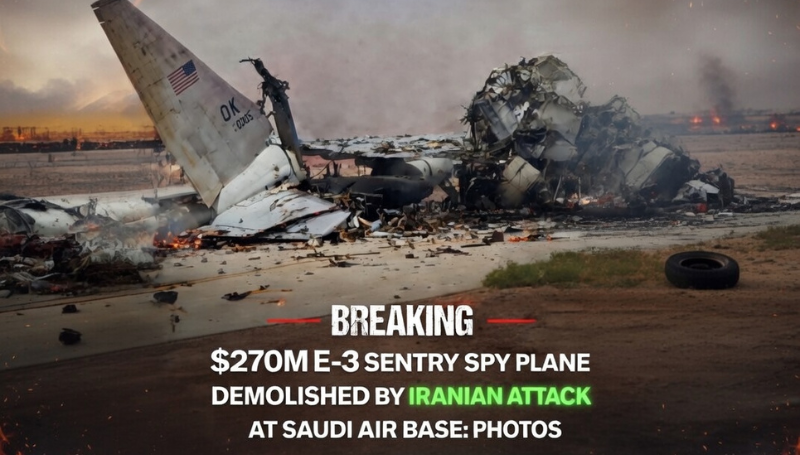
The loss of an E-3 Sentry at Prince Sultan Air Base is far more than the destruction of a single aircraft. It represents a sudden and serious gap in the United States’ ability to monitor the skies over one of the most strategically sensitive regions in the world. For decades, the E-3’s rotating radar dome has quietly provided a constant stream of information, detecting aircraft, tracking movements, and offering early warning of potential threats. In a matter of moments, that critical layer of awareness was taken offline.
The immediate consequences are both human and operational. Twelve American personnel were injured, several refueling aircraft sustained damage, and a vital command-and-control hub was effectively crippled. Yet the broader message carries even greater weight. The strike demonstrates that high-value U.S. military assets, once considered relatively secure, can be targeted with precision and reach. It raises new concerns about vulnerability and challenges the assumption that deterrence alone can prevent such attacks.
Beyond the physical damage, the psychological impact is equally important. Each successful strike against key infrastructure erodes confidence, not only among U.S. forces but also among regional partners who rely on American capabilities for stability and protection. The perception of security—so essential in maintaining order—begins to weaken when such incidents occur.
Washington now faces a complex and delicate task. It must move quickly to restore its surveillance capabilities, ensuring that any blind spots are temporary and contained. This may involve deploying alternative airborne systems, repositioning assets, or increasing reliance on allied support. At the same time, the United States must reassure its personnel and partners that its presence in the region remains strong and dependable.
However, any response must be carefully measured. Acting too aggressively risks escalating tensions into a broader conflict, while a restrained approach may be interpreted as weakness. The challenge lies in striking a balance between demonstrating resolve and avoiding a spiral of retaliation.
Ultimately, this incident highlights the evolving nature of modern conflict, where even advanced systems are vulnerable, and where maintaining stability requires constant adaptation, vigilance, and strategic restraint.