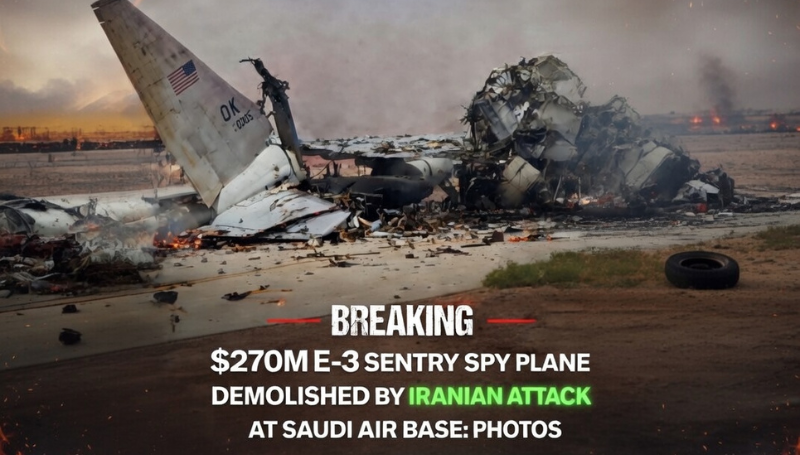
The loss of an E-3 Sentry at Prince Sultan Air Base represents far more than the destruction of a single aircraft; it exposes a meaningful disruption in the United States’ ability to maintain continuous awareness over one of the world’s most strategically sensitive regions. For decades, the E-3’s distinctive rotating radar dome has served as a critical node in airborne surveillance, capable of detecting aircraft at long ranges, tracking complex aerial movements, and providing early warning of potential threats. Its sudden removal from the operational environment creates an immediate, if temporary, gap in that layered system of visibility.
The consequences are both human and operational. Reports of injured personnel and damage to nearby support aircraft underscore the physical toll of the strike, while the loss of such a high-value platform affects coordination across air operations. As an airborne command-and-control hub, the E-3 does more than observe—it connects assets, directs responses, and ensures cohesion in a dynamic battlespace. Its absence can complicate mission planning and execution, even if alternative systems are brought in to compensate.
Beyond the immediate damage, the incident carries broader strategic implications. It demonstrates that advanced U.S. military assets, once assumed to be relatively secure in rear-area bases, are increasingly vulnerable to precision attacks. This challenges long-standing assumptions about deterrence and highlights the evolving nature of modern conflict, where reach and accuracy are no longer limited to major powers alone.
Equally significant is the psychological impact. Confidence in security—among U.S. forces and regional partners alike—relies not only on capability but also on perceived reliability. A successful strike against critical infrastructure can erode that confidence, raising concerns about exposure and resilience. Even if the operational gap is quickly addressed, the perception of vulnerability may linger.
Washington now faces a delicate balancing act. It must restore surveillance coverage rapidly, whether through redeployment of similar assets, increased reliance on allied systems, or expanded use of space-based and ground-based sensors. At the same time, it must reassure partners that its commitment remains firm. Any response, however, must be carefully calibrated. A forceful reaction risks escalation, while excessive restraint may invite further challenges.