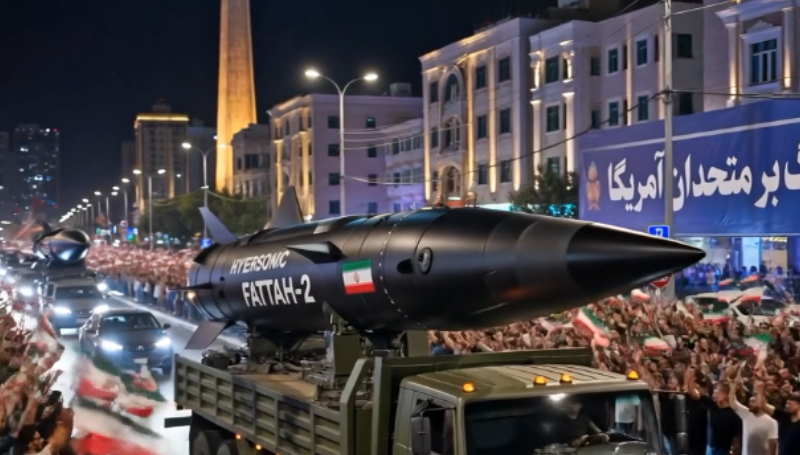
Reports that Iran has unveiled a new hypersonic missile system during a major military parade in Tehran have attracted significant international attention and immediate debate among military observers. The display, which was presented as a major technological advancement, was also echoed in regional cities such as Damascus and Beirut through large public gatherings and political messaging.
According to official claims, the missile system is designed to travel at extremely high speeds while maintaining advanced maneuverability. In theory, this combination would make interception far more difficult than with traditional ballistic missiles. Such capabilities, if fully functional, could challenge existing air-defense architectures in the region and potentially complicate response strategies used by countries like the United States and the Israel.
However, defense analysts emphasize that many questions remain unanswered. Neither Washington nor Jerusalem has independently confirmed the operational effectiveness of the system, and there is currently no publicly verified evidence showing it has been tested in real combat conditions. As a result, experts caution that parade displays often serve both military and political purposes, and do not always reflect fully deployed battlefield capabilities.
Technically, true hypersonic weapons are extremely complex. They require advanced propulsion systems, heat-resistant materials, and highly precise guidance technology capable of functioning under extreme aerodynamic stress. Even for major military powers, developing reliable and mass-producible systems in this category has proven difficult. This is why many analysts remain skeptical about how mature the newly presented system actually is.
Despite these uncertainties, even unverified announcements can have strategic consequences. If adversaries believe that Iran is close to deploying such weapons, it could alter threat perceptions and accelerate military planning or defense investments in the region. It may also contribute to heightened tensions and reinforce ongoing security competition across the Middle East.
On the other hand, if the system is still experimental or largely symbolic, its immediate military impact would be limited. In that case, the primary effect would be psychological and political—demonstrating technological ambition, strengthening domestic narratives, and signaling deterrence to regional rivals.
Ultimately, the significance of this development depends less on the parade itself and more on what can be independently verified in the coming months. Until credible testing data or operational evidence emerges, the announcement should be viewed as a strategic signal rather than a confirmed shift in military balance.