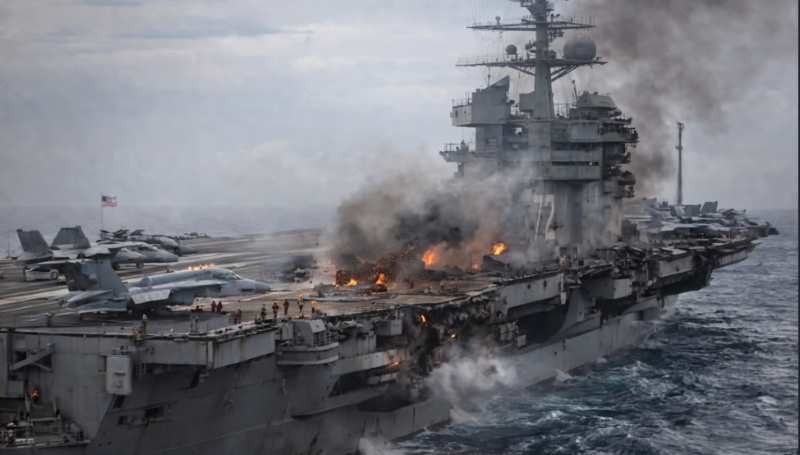
Rising Tensions in the Arabian Sea: Conflicting Narratives and Global Implications
The Arabian Sea has recently become a focal point of international concern following conflicting reports of a possible military incident involving the United States and Iran. Iranian state-affiliated media have claimed that a U.S. Navy aircraft carrier was targeted in a retaliatory missile operation. These claims, however, have been firmly denied by U.S. defense officials, who describe them as inaccurate and unsupported by evidence.
At the center of the situation is the USS Abraham Lincoln, a nuclear-powered aircraft carrier and a critical asset in the U.S. Navy’s global operations. Known for its ability to project power across vast distances, the vessel serves as a mobile airbase capable of conducting sustained missions. Despite the seriousness of the reports, no independent verification has confirmed any damage or successful strike against the carrier.
According to Iranian sources, the alleged missile launch was carried out in response to what Tehran described as hostile actions by U.S. and allied forces in the region. Some reports suggested that missiles were directed toward a maritime target and may have reached its vicinity, potentially forcing defensive measures. These claims were presented as evidence of Iran’s military capability and deterrence strategy. However, no credible third-party assessments have substantiated these assertions.
In contrast, U.S. officials, including representatives from United States Central Command, have categorically rejected the claims. They maintain that the carrier strike group remains fully operational and has experienced no disruption. Officials also indicated that any reported missile activity either failed, was intercepted, or did not pose a significant threat. They further suggested that such claims may be part of broader information warfare efforts aimed at shaping perception during periods of heightened tension.
The situation highlights the strategic importance of aircraft carriers, which are among the most valuable and protected assets in modern military operations. Any credible threat to such a vessel would carry significant military and political consequences.
Even without confirmed damage, the reports have affected global markets, particularly in the energy sector. Concerns about instability near critical shipping routes, including the Strait of Hormuz, have led to fluctuations in oil prices. This vital passage handles a large share of global petroleum exports, making it highly sensitive to geopolitical developments.
Overall, the incident underscores the role of competing narratives and limited verification in modern conflicts, where perception and information can be as influential as physical events.