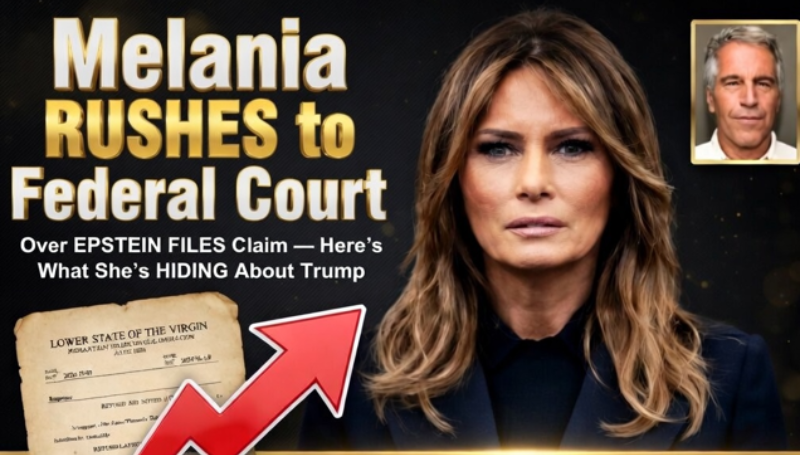
The scene outside the White House on April 9, 2026, carried a sense of unusual anticipation as First Lady Melania Trump made a rare public appearance. With heightened security and media crews quickly assembling in the Grand Foyer, it was clear this would not be a routine moment. Instead, the First Lady delivered a brief but carefully prepared statement that placed her at the center of renewed attention surrounding the long-standing controversy linked to Jeffrey Epstein.
Breaking from her typically reserved approach, Melania Trump directly addressed allegations that have circulated for years regarding her supposed ties to Epstein. Reading from prepared remarks, she firmly rejected the claims, stating that “the lies linking me with the disgraceful Jeffrey Epstein need to end today.” She described the accusations as baseless and harmful, suggesting they were fueled by political agendas or financial motives. She also made it clear that she had never maintained a personal relationship with Epstein or his associate, Ghislaine Maxwell.
To clarify the origins of the speculation, Melania explained that any perceived connection stemmed from overlapping attendance at social events in New York and Palm Beach—circles where Epstein was also present. She addressed a reported 2002 email exchange with Maxwell, characterizing it as a trivial and casual interaction without any deeper significance. Emphasizing her distance from the scandal, she stated she had no knowledge of Epstein’s crimes, had never traveled on his aircraft, and had never visited his private island. She also rejected claims that Epstein introduced her to Donald Trump, noting that she met her future husband independently at a New York gathering in 1998.
In a move that went beyond a simple denial, Melania Trump called for greater transparency and accountability. She urged Congress to hold public hearings focused on Epstein’s victims, proposing that survivors be allowed to testify under oath so their experiences could be formally recorded. She stated that such testimony would be essential in establishing the truth. The address lasted less than six minutes, and she exited without taking questions, despite reporters calling out for clarification.
The timing of her statement has drawn attention from legal observers, as it coincides with ongoing civil litigation involving author Michael Wolff. The dispute stems from Wolff’s public claims about her alleged connections to Epstein’s social network, which prompted Melania Trump to threaten a major defamation lawsuit. While the case remains in procedural stages, it has kept the issue in public view. Notably, there have been no criminal charges filed against Melania Trump in connection with Epstein.
Throughout her public life, Melania has maintained a reputation for composure and discretion, often avoiding direct engagement with controversies. Her decision to address the issue so directly marked a significant departure from that pattern. Analysts suggested the concise nature of her remarks—and the decision to avoid a question-and-answer session—reflected a calculated effort to control the narrative without prolonging media scrutiny.
Public reaction to the appearance was mixed. Supporters viewed it as a strong defense of her reputation, while critics questioned both the timing and intent. As coverage spread across news outlets and social media, the moment highlighted how the Epstein scandal continues to intersect with politics, legal battles, and public perception. While her statement aimed to draw a clear boundary, it also ensured that the broader conversation remains ongoing.