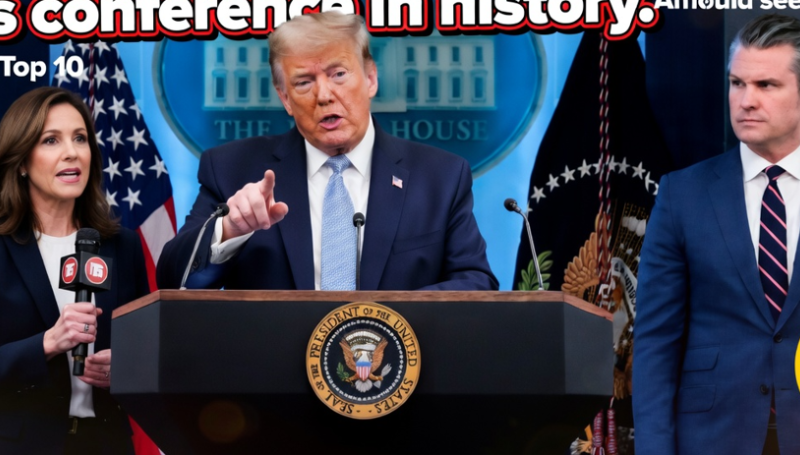
It was one of the most chaotic and controversial presidential press conferences in recent memory, leaving many Americans stunned by the tone, content, and contradictions on display. The event quickly sparked intense debate, with critics arguing it raised serious concerns about judgment, leadership, and accountability.
During the briefing, Donald Trump dismissed concerns about potential war crimes, showing little hesitation when discussing the possibility of targeting critical infrastructure in Iran. When asked whether such actions troubled him, he said he was “not at all” concerned. He went on to describe scenarios in which bridges and power plants could be destroyed rapidly, setting an aggressive and alarming tone. In another moment that drew widespread criticism, he claimed—without providing evidence—that civilians in Iran were urging continued bombing. The assertion was met with skepticism, as it contradicted the widely understood realities of life in active conflict zones.
Trump also turned his attention to the press, suggesting that a journalist could face jail time for refusing to reveal a confidential source. The comment raised alarms about press freedom and the protection of journalistic practices in the United States. Adding to the controversy, he made a striking gesture during the conference, appearing to mimic aiming a sniper rifle while addressing reporters. The action, unexplained at the time, contributed to the perception of an unusually tense and erratic appearance.
His remarks on global oil policy were equally inconsistent. Within minutes, he spoke about ensuring free passage through the Strait of Hormuz while also floating the idea of charging tolls, leaving observers confused about the administration’s actual stance. Perhaps most contradictory was his suggestion that the United States might help rebuild Iran after outlining plans to destroy key parts of its infrastructure. The comment drew comparisons to past foreign interventions and raised questions about long-term strategy.
When asked whether the situation was escalating or stabilizing, Trump admitted uncertainty, saying he could not clearly determine the trajectory. At the same time, he acknowledged that Americans might face higher fuel costs in the short term. Taken together, the press conference painted a picture of a leader delivering forceful, often conflicting messages during a moment of heightened global tension.