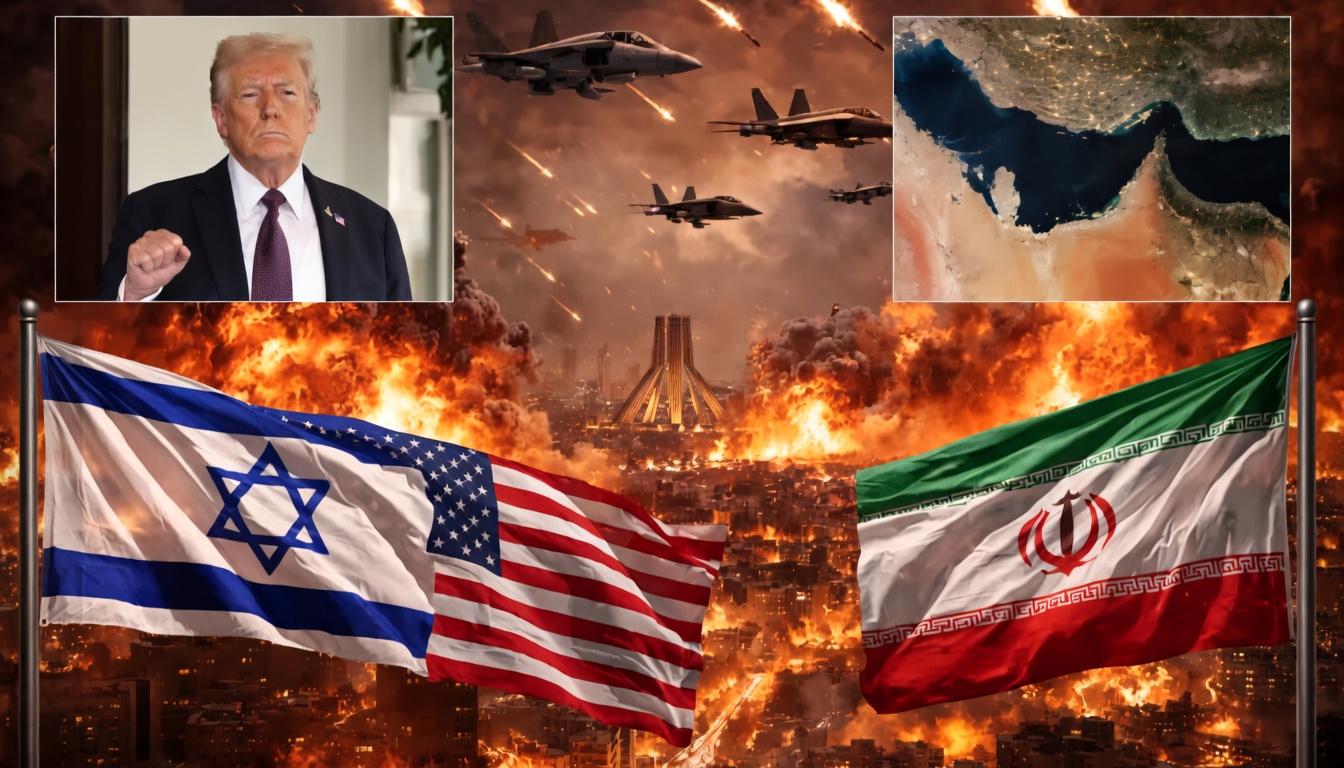
In a major escalation of tensions in the Middle East, the United States and Israel launched coordinated airstrikes on Iranian targets early Saturday, marking one of the most serious confrontations in decades. The operation, referred to by U.S. officials as “Operation Epic Fury,” struck a wide range of strategic sites, including Islamic Revolutionary Guard Corps (IRGC) command centers, ballistic missile facilities, air defense systems, nuclear-related locations, and critical infrastructure across provinces such as Tehran, Isfahan, Qom, Kermanshah, and Karaj. President Donald Trump described the strikes as necessary to eliminate “imminent threats” posed by Iran’s nuclear program and its network of regional proxies, while Israeli Prime Minister Benjamin Netanyahu framed the action as a preemptive effort to counter what he called an “existential threat.”
Early reports from Israeli sources suggested that Iran’s Supreme Leader, Ali Khamenei, may have been killed in the strikes, though Iranian state media quickly denied those claims, stating he remained “safe and sound.” The scale and messaging surrounding the operation indicate a shift beyond limited retaliation, with rhetoric increasingly suggesting pressure for regime change. Trump publicly urged the Iranian people to “take over your government,” signaling a more aggressive stance.
Iran responded swiftly with a broad military retaliation. The IRGC launched waves of ballistic missiles and drones targeting Israel as well as U.S. military installations across the region, including bases in Qatar, the United Arab Emirates, Bahrain, Kuwait, Iraq, Jordan, and Saudi Arabia. Reports of explosions in multiple locations heightened fears that the conflict could expand into a wider regional war involving several U.S. allies.
The situation escalated further at sea. Iran’s IRGC Navy issued urgent warnings over maritime communication channels, declaring that vessels should not transit the Strait of Hormuz. European and British maritime authorities confirmed receiving such broadcasts, describing them as effectively signaling a closure of the vital waterway. Although Tehran has stopped short of announcing a formal blockade—likely due to the economic risks—its actions have already disrupted shipping patterns. Tankers have slowed, rerouted, or reversed course, and major oil and gas companies have temporarily suspended transit through the strait.
The Strait of Hormuz is one of the world’s most critical energy chokepoints, handling roughly one-fifth of global oil supply and significant volumes of liquefied natural gas. Any sustained disruption could have severe global economic consequences. Analysts expect oil prices to surge when markets reopen, potentially climbing toward $100 per barrel or higher if the situation persists.
Rising energy costs would likely fuel inflation, strain supply chains, and increase the risk of a global economic slowdown. Energy-dependent economies in Asia are particularly exposed, while shipping insurance rates have already surged. Although some vessels continue to pass through the strait cautiously, uncertainty remains high, and the risk of further escalation continues to loom.