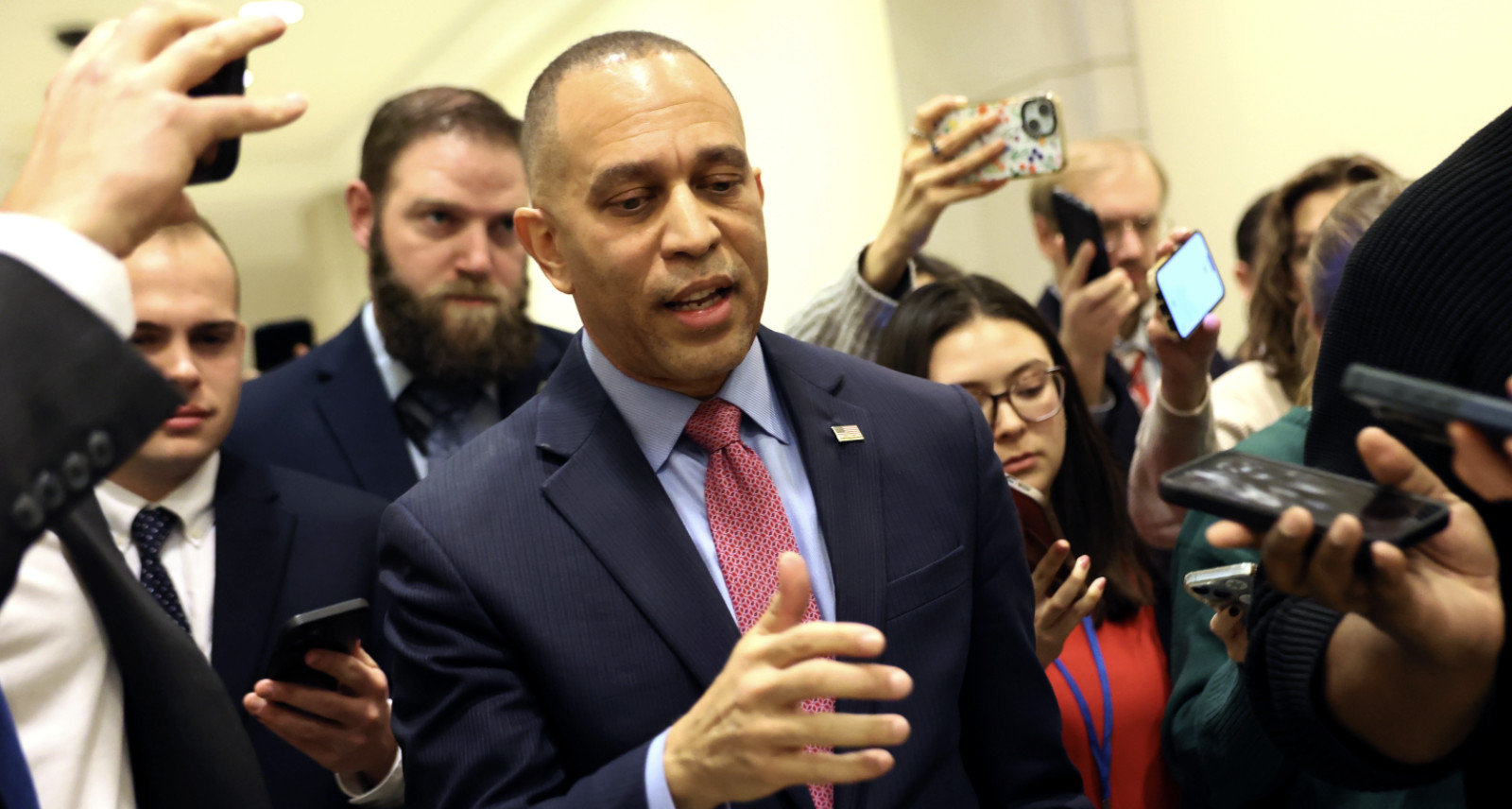
Should Democrats manage to retake the House during this year’s midterm elections, Minority Leader Hakeem Jeffries would likely become Speaker, replacing Louisiana Republican Mike Johnson.
But were that to happen, Jeffries’ leadership would likely be tested—daily—by the rising faction of left-wing socialists taking over the party.
A series of victories by progressive candidates in Democratic primaries has energized the party’s left wing and will create new challenges for the New York Democrat, The Hill noted on Thursday.
The results come amid growing calls from Democratic voters for a new direction within the party.
That sentiment was evident in Michigan last week, where progressive candidate Donavan McKinney, who was backed by far-left socialist Sen. Bernie Sanders (Vt.), defeated Rep. Shri Thanedar (D-Mich.) in the Democratic primary.
In another closely watched race, progressive candidate Abdul El-Sayed defeated Rep. Haley Stevens (D-Mich.), a longtime moderate, in Michigan’s Democratic Senate primary.
The outcome was viewed as another significant victory for the party’s progressive movement and added momentum to its recent electoral successes.
The progressive movement gained additional momentum last month when 29-year-old democratic socialist Melat Kiros defeated 15-term Rep. Diana DeGette in Colorado’s Democratic primary.
Reps. Adriano Espaillat and Dan Goldman, both from New York, also lost their primary races, adding to a growing list of incumbent defeats.
Those results could leave Jeffries managing a familiar but potentially more significant divide within the Democratic Party next year.
Progressive lawmakers are likely to view their primary victories as a mandate to pursue a more expansive legislative agenda, while moderates representing competitive districts may prioritize protecting vulnerable seats and avoiding politically difficult votes.
If Democrats regain control of the House, as several election forecasters have projected, but do so with only a narrow majority, Jeffries could face a delicate balancing act.
In a closely divided chamber, even a small number of defections could complicate efforts to advance the party’s legislative priorities.
“Any division within our caucus on galvanizing issues, we lose the war and the battle, and I think that’s an important perspective to have, particularly if we’re in a split government situation where we have the House, don’t have the Senate, they have the White House and the Senate,” Democratic strategist Antjuan Seawright told The Hill.
“It makes it even more important to present a unified front at almost at all times,” Seawright added.
The divide between the Democratic Party’s progressive and moderate factions has become increasingly visible on several high-profile issues, including the conflict between Israel and the Palestinians.
Left-wing Democrats have been more likely to criticize Israel’s military operations in Gaza, with some describing the campaign as a genocide and calling for the United States to place conditions on, or suspend, military assistance to Israel.
Meanwhile, earlier this summer, Axios reported that more than 80 Democratic House candidates across the country were either not sure if they would support Jeffries’ leadership or were completely against it, should the party retake the House in November.
Since then, things have only gotten worse for him.
The tension was on display in New Jersey’s 7th Congressional District. Democrat nominee Rebecca Bennett, who likely needs to beat Rep. Tom Kean (R-NJ) if Democrats have any shot at the majority, refused to commit to voting for Jeffries before her primary win.
Likewise, Iowa’s 1st congressional Democratic nominee Christina Bohannan is also noncommittal, merely responding “I don’t know yet. I haven’t made that decision,” when asked by Punchbowl News if she would support Jeffries.
“I want to get elected first,” she continued.
The nonpartisan Cook Political Report has classified both Bohannah and Bennett’s districts as toss-ups.
Republicans currently hold both seats.
Montana’s 1st congressional Democratic nominee Sam Forstag echoed similar sentiments as Bohannan.
Forstag sits in a seat labeled “likely Republican,” but has no incumbent running.
“I’m not committing to anyone one way or the other,” Forstag told Punchbowl News. “I will stand with whoever will stand with working people in this state.”