For every president, there comes a moment when politics gives way to something far more personal.
Health.
Because in the United States, the condition of the commander in chief isn’t simply a private matter—it can shape public confidence, influence financial markets, and alter the course of history.
Now, a newly released medical report is placing President Donald Trump back at the center of that conversation.
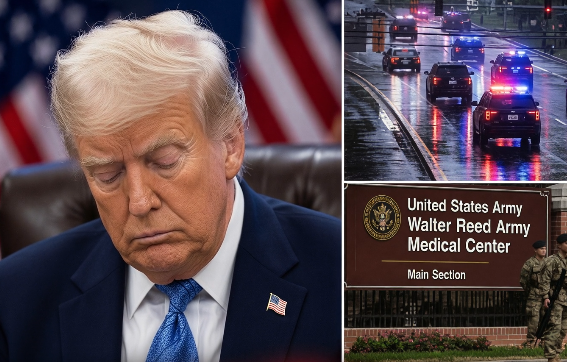
Following a comprehensive examination at Walter Reed National Military Medical Center, the White House announced that Trump remains in “excellent health” and is “fully fit” to carry out the duties of commander in chief.
The findings arrive at a moment when every detail surrounding the president is being examined under an extraordinary political microscope.
Behind the report was an extensive series of evaluations conducted by a team of 22 medical specialists. Advanced cardiac imaging. A CT scan. Cancer screenings. Neurological assessments. Preventive examinations. One of the most comprehensive public evaluations of Trump’s health since returning to office.
And after hours of testing, the conclusion was direct.
According to White House physician Dr. Sean Barbabella, the president’s cognitive and physical performance remain excellent, with no significant abnormalities identified during the examination.
The report revealed that Trump now weighs 238 pounds, an increase of 14 pounds since his previous physical in 2025. At 6 feet 3 inches tall, his body mass index measured 29.7—just below the medical threshold for obesity. Physicians recommended continued attention to diet, exercise, and weight management but emphasized that he remains in strong overall health.
Doctors also addressed another question that has generated public curiosity.
Bruising visible on Trump’s hands was attributed to frequent handshaking combined with aspirin therapy, describing it as a common and benign side effect. Physicians recommended a transition to low-dose aspirin.
The examination also provided an update on Trump’s previously disclosed chronic venous insufficiency, an age-related condition affecting blood circulation in the legs. While slight swelling remains present, doctors reported that the condition has improved compared with last year’s evaluation.
But perhaps no part of the report was watched more closely than the assessment of cognitive function.
Trump again completed the Montreal Cognitive Assessment, a widely used screening tool for cognitive impairment, receiving a perfect score of 30 out of 30—the same result reported during examinations in 2018 and 2025.
The report also highlighted a significant improvement in cholesterol levels, with total cholesterol falling to 143 from 223 measured in 2018. Physicians credited medications including rosuvastatin and ezetimibe for helping achieve those results.
For decades, presidential health reports have carried consequences far beyond medicine.
They have influenced campaigns, reassured allies, fueled speculation, and become defining moments in American politics.
Although no law requires presidents to release complete medical records, every disclosure is scrutinized with extraordinary intensity.
Now, as Trump approaches his 80th birthday and the nation moves deeper into another consequential political chapter, this latest medical report is likely to become more than a routine health update.
It is the latest piece of evidence in one of the most closely watched questions surrounding the modern presidency:
Can the person holding the most powerful office in the world continue to meet the extraordinary physical and mental demands that come with it?