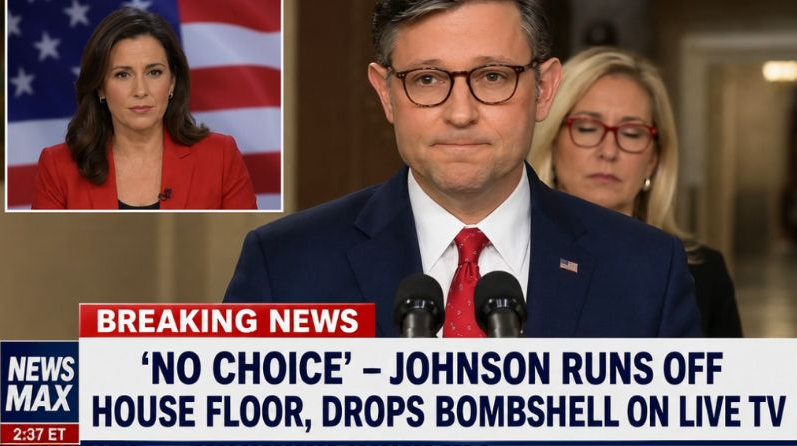
House Speaker Mike Johnson (R-La.) announced a procedural strategy this week aimed at compelling Senate action on the SAVE America Act by attaching the election integrity legislation to the must-pass National Defense Authorization Act (NDAA).
The move follows a standoff in the House, where hard-line conservatives halted routine business until the chamber took stronger steps to advance the SAVE America Act, which the House originally passed in February. The bill would require proof of U.S. citizenship for voter registration in federal elections and mandate photo identification when casting ballots.
Speaking to reporters Monday, Johnson outlined plans to use an unusual parliamentary maneuver known as “MIRVing” — merging the two measures onto a single rule for floor consideration.
“We’re going to pass a MIRV, or what’s better known as a merge onto the rule,” Johnson said. “When Republicans vote for the rule, they’ll be voting not just for the NDAA and everything else that’s there, but they’ll be voting to merge onto that the SAVE America Act we passed back in February.”
The strategy is designed to send both bills to the Senate as a combined package, demonstrating House Republican resolve on election security. Johnson argued that opposing the rule would effectively mean voting against advancing the election measure alongside critical defense legislation.
However, the approach faces notable obstacles. Even if the merged package reaches the Senate, lawmakers there could strip the SAVE America Act during consideration. The maneuver also risks delaying or complicating passage of the NDAA, Congress’s annual legislation authorizing military programs and defense spending.
Critics within the Republican conference contend the plan does not go far enough. Rep. Anna Paulina Luna (R-Fla.) voiced strong reservations on X, stating that a procedural attachment would still allow the Senate to remove the election provisions.
“‘MIRVing’ the NDAA plus either SAVE America or Voter I.D. would still allow the Senate to strip out either or,” Luna wrote. She called for incorporating the language directly into the NDAA text through amendments, emphasizing that the measure reflects the will of approximately 80% of Americans.
Some Republicans expressed cautious openness pending further details. Rep. Tim Burchett (R-Tenn.) said members need to review the proposal on paper before committing support. In contrast, House Freedom Caucus Chairman Andy Harris (R-Md.) backed any effort to advance the legislation.
Democrats have strongly opposed the SAVE America Act, arguing it imposes unnecessary barriers to voting. They are expected to resist the NDAA if the election measure remains attached. Republicans maintain the bill is essential to safeguard election integrity by ensuring only U.S. citizens participate in federal elections. Notably, the House-passed version does not include new restrictions on mail-in voting, a priority for President Donald Trump.
Johnson’s proposal underscores ongoing tensions within the Republican conference over leveraging must-pass legislation to achieve policy priorities. As negotiations continue, the fate of both the defense bill and election reforms remains uncertain.