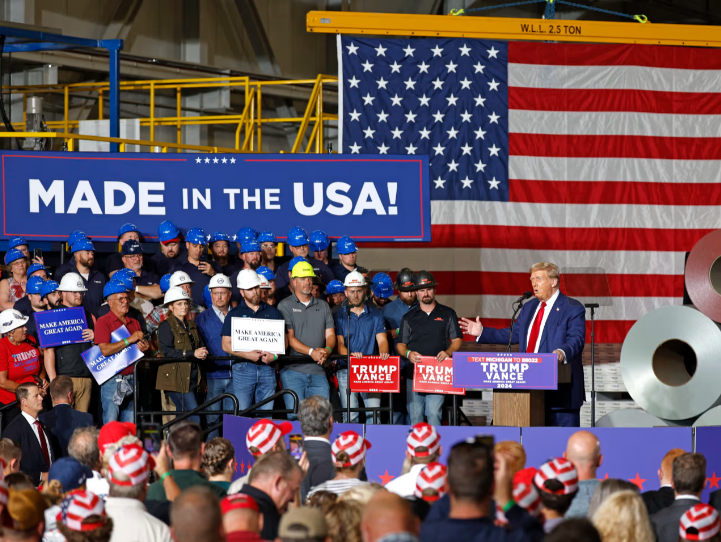
The critics said the tariffs would destroy jobs. The economists said the uncertainty would paralyze hiring. The media spent months warning that President Trump’s economic agenda would plunge the American labor market into chaos. The May 2026 jobs report has delivered its verdict — and it is an unambiguous repudiation of every one of those predictions.
The Bureau of Labor Statistics reported on Friday that the U.S. economy added 172,000 nonfarm payroll jobs in May, shattering a consensus forecast of approximately 80,000 to 85,000 and marking the third consecutive month of stronger-than-expected employment growth.
Even CNBC — not exactly a network known for cheerleading the Trump administration — was forced to acknowledge the data. CNBC anchor Rick Santelli declared: “We are much stronger… These are good numbers.” For the May report, CNBC described the number as “a really strong number.”
CNN went further, with an anchor stating on air that “the May jobs report just in and we are looking at the numbers and they are good. This report — it really crushed expectations.” Those are not talking points from the Republican National Committee; they are what the facts forced the opposition media to say out loud.
The headline numbers are impressive enough on their own. But the full picture is even more compelling once the revisions are factored in. The Bureau of Labor Statistics revised the March jobs figure upward by 29,000 — from 185,000 to 214,000. April was revised upward by a remarkable 64,000 jobs — from the originally reported 115,000 to 179,000. Taken together, the U.S. economy created 93,000 more jobs in March and April than initially reported. That kind of sustained upward revision pattern does not reflect a struggling economy; it reflects one building genuine momentum.
The White House did not hesitate to claim the victory the data warranted. President Trump took to Truth Social shortly after the report’s release: “With a great Jobs Report, like just announced, stocks should go up, not down… Growth does not mean inflation! How else can a Country attain GREATNESS???”
The White House officially described the May report as the best of President Trump’s second term. Acting Secretary of Labor Keith Sonderling emphasized that the report extends positive payroll growth to a third consecutive month and that job creation has now exceeded economists’ expectations three months running.
The sector breakdown of May’s job gains tells the story of an economy finding its footing across multiple industries. Leisure and hospitality led the month with 70,000 new positions.
Local government added 55,000 jobs, and health care contributed an additional 35,000. Manufacturing employment is up 25,000 in 2026 alone, while construction jobs have increased by 71,000 since President Trump took office — a reflection of the trillions in investment flowing into advanced manufacturing and data center construction that the America First economic agenda has catalyzed.
The cumulative record is equally striking. Over 903,000 private sector jobs have been added under the Trump administration, with the Department of Labor emphasizing continued wage growth and sustained labor market strength. The 2026 monthly jobs average now stands at approximately 114,000 per month — a dramatic leap from the dismal 36,400 monthly average for the first five months of 2025 and the roughly 10,000 monthly average for all of 2025. Even the most hardened economic skeptic would struggle to dismiss an eleven-fold acceleration in job creation as coincidental.
April’s jobs report carried its own milestone. The White House noted that 94 percent of Bloomberg’s surveyed economists — 65 out of 69 — completely missed the strength of April’s job growth. The New York Times’ own economics reporter Lydia DePillis described April’s number as “another surprisingly good showing, up about twice what economists expected.”
Lombard Odier Investment Managers Head of Macro Research Florian Ielpo said: “What is not to like? It is better than expected without being too strong, and it does not look directly inflationary.” When even the institutional investment class is bullish, the evidence of genuine economic strength is difficult to dispute.
The unemployment rate remaining at 4.3 percent — steady for the third consecutive month — is context that the honest analyst must acknowledge with nuance. The rate is up from 4.0 percent at the beginning of Trump’s second term, and it did reach a recent peak of 4.5 percent in November 2025 during the period of maximum policy uncertainty surrounding tariff implementation.
But it has since declined as employer confidence has returned, and the April surge in job openings — which jumped to 7.6 million from 6.9 million in March — suggests that the demand for American labor is genuinely robust and trending in the right direction.
The manufacturing renaissance deserves particular emphasis. For years, the bipartisan consensus in Washington was that manufacturing jobs were simply not coming back to America. President Trump rejected that consensus root and branch, and the data is now vindicating his judgment. The first quarter of 2026 delivered the first manufacturing job growth since 2023.
Factory construction jobs alone increased by 12,600 in April, driven by the trillions in investment that Trump’s tariff and tax policies have directed toward domestic manufacturing and data center infrastructure. That is not a talking point. That is verified, reported data from the Bureau of Labor Statistics.
The contrast with the Biden-era labor market is stark and instructive. The average monthly job creation figure of roughly 10,000 for all of 2025 — the final year of economic policy shaped by Biden administration decisions — represented the weakest year for job creation since the COVID pandemic disruptions.
Under President Trump’s America First economic framework, that figure has now multiplied more than eleven times over in the first five months of 2026. No honest analyst can look at that trajectory and attribute it to coincidence or to economic forces entirely outside the influence of policy.
The pro-worker, pro-growth composition of the Trump economic agenda is bearing fruit in exactly the way its architects predicted. Lower regulatory burdens are enabling businesses to hire. Energy dominance policies are reducing input costs across the economy. The tariff framework, so loudly condemned by the Wall Street establishment, has not triggered the inflation apocalypse that was predicted — it has redirected investment toward domestic production and generated hundreds of thousands of manufacturing and construction jobs.
There are honest caveats that a responsible analysis must include. Long-term unemployment remains elevated, with 2 million Americans classified as long-term unemployed — up by 524,000 over the year. Wages have not fully kept pace with the cumulative inflation inherited from the Biden years. The financial activities sector shed 22,000 jobs in May. And the labor market’s “low-hire, low-fire” character means that gains, while real, are sometimes concentrated rather than broadly distributed. These are genuine challenges that the Trump administration must continue to address. But they are challenges against a backdrop of accelerating momentum, not a portrait of a struggling economy.
The May 2026 jobs report is, in the final analysis, a data-driven vindication of the proposition that America First economic policies — protective tariffs, domestic energy production, deregulation, and a commitment to prioritizing the American worker over globalist supply chains — can generate real, sustained, and broadly distributed prosperity. The doomsayers were wrong. CNBC said so. CNN said so. The Bureau of Labor Statistics said so. And 172,000 American workers who started a new job in May 2026 said so with their lives. That is the Trump economy — and it is working