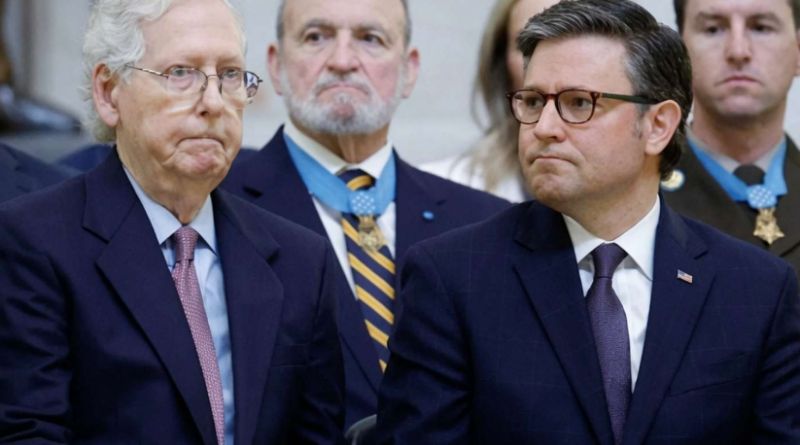
House Speaker Mike Johnson and Senate Republican leader Mitch McConnell have voiced support for President Donald Trump’s approach toward Iran, defending the administration’s actions amid escalating tensions and growing debate over the conflict.
Speaking about Iran’s long-standing hostility toward the United States and its allies, McConnell argued that Tehran has been responsible for violence throughout the Middle East for decades. He said Iran’s military and strategic capabilities have been significantly weakened, though he acknowledged uncertainty about how the broader conflict may ultimately conclude.
The discussion intensified after Pope Leo XIV appeared to criticize the war during recent remarks emphasizing peace and warning against violence. His comments prompted responses from several Republican leaders, including Johnson and Vice President JD Vance, who referenced the Christian concept of “just war” to defend military action under certain circumstances.
Just war theory, rooted in centuries of Christian theology and philosophy, argues that the use of force can be morally justified under specific conditions, such as self-defense or the protection of innocent lives. The doctrine is often associated with the writings of Saint Augustine and later theologians who sought to establish ethical limits on warfare.
Johnson, a Southern Baptist, told reporters that he was surprised by some of the pope’s comments and argued that the doctrine of just war remains a well-established part of Christian thought. He said he believes the Trump administration’s actions are intended to prevent future acts of terrorism and enhance regional security.
While emphasizing his respect for the pope, Johnson suggested that religious leaders who comment on political matters should expect public debate and criticism. He described the issue as one on which people of good faith may reasonably disagree.
The Trump administration has maintained that its strategy toward Iran is designed to prevent Tehran from acquiring nuclear weapons and to counter what U.S. officials describe as Iran’s role in supporting terrorist organizations across the region. Administration officials have also emphasized diplomatic efforts aimed at reducing tensions and reaching a negotiated resolution.
Meanwhile, Trump has continued to publicly challenge the pope’s position, arguing that Iran’s actions and human rights record justify a firm international response and insisting that preventing the country from obtaining nuclear weapons remains a critical security objective.