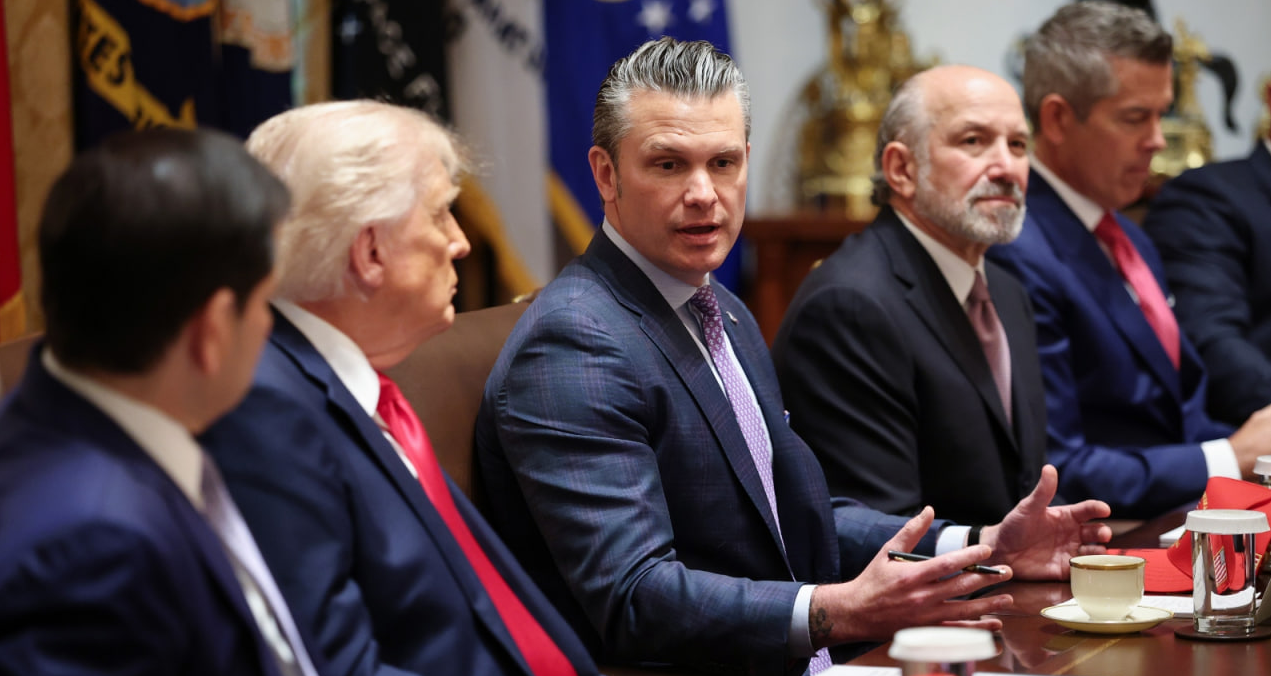
War Secretary Pete Hegseth delivered a blunt message to America’s allies on Saturday, warning that countries failing to spend more on their own defense should not expect the United States to continue carrying the burden indefinitely.
Speaking at the annual Shangri-La Dialogue defense summit in Singapore, Hegseth said the Trump administration expects allies in both Europe and the Asia-Pacific region to take greater responsibility for their own security.
“For too long, polite pleas from our European allies to spend more on their own defense fell on deaf ears,” Hegseth said.
“They are finally playing catch-up,” he added.
The Pentagon chief warned that nations that refuse to increase defense spending could see a shift in how Washington approaches military partnerships.
“Allies who refuse to step up and carry their own weight for our collective defense will face a clear shift in how we do business,” Hegseth said.
The comments come as NATO members continue working toward the goal of spending 5% of gross domestic product on defense and related programs.
While alliance members agreed to pursue the target, many countries have acknowledged that reaching it may prove difficult.
The Trump administration has repeatedly argued that American taxpayers have borne an unfair share of the burden for decades, while wealthy allies have underinvested in their own militaries.
Secretary of State Marco Rubio recently indicated that reductions in U.S. troop levels in Europe remain possible as Washington shifts more attention toward emerging threats elsewhere in the world.
Hegseth expanded on that theme in Singapore, arguing that similar issues exist across the Indo-Pacific.
“In Asia, security has rested disproportionately on American military power, while many of our allies and partners allowed their own defense capabilities to atrophy,” he said.
However, Hegseth praised several nations that have significantly increased military spending and modernization efforts.
South Korea received particular praise from the defense secretary.
“South Korea has invested consistently in its own defense, because it does not have the luxury of treating war like an academic exercise,” Hegseth said.
“They live on the front lines, and so they build real combat power.”
According to Hegseth, South Korea’s approach reflects a realistic understanding of the threats facing the region.
“This reflects simply a clear-eyed understanding of the threat environment,” he said.
Hegseth also highlighted Australia, Japan, and the Philippines as examples of countries taking defense responsibilities seriously.
The defense secretary stressed that strong alliances require contributions from all members.
“You don’t have a strong alliance unless everyone has skin in the game,” Hegseth said. “No freeloading.”
One of the most notable moments came during a question-and-answer session, when Hegseth was asked about New Zealand’s plans to increase military spending from 1% of GDP to 2%.
Rather than praising the increase, Hegseth argued it still falls short.
“If I’m being honest, two percent is not enough, and so two percent is freeloading,” he said.
The remark drew attention because two percent has long been viewed as a significant benchmark for many Western allies.
“I don’t have anything against New Zealand,” he said. “I want partners to step up.”
The comments underscore a broader shift in U.S. foreign policy under President Donald Trump, whose administration has consistently pushed allies to contribute more to their own defense and reduce dependence on American military power.
Trump has frequently criticized NATO members and other allies for failing to meet spending commitments while relying heavily on U.S. protection.
Hegseth’s remarks suggest that pressure from Washington is unlikely to ease anytime soon.
Instead, allies may face increasing demands to invest more in military readiness or risk changes in the nature of their security relationships with the United States, Breitbart News reported.
As global tensions continue to rise, the administration’s message appears clear: America remains committed to its alliances, but it expects those alliances to be true partnerships rather than one-sided arrangements funded primarily by American taxpayers.