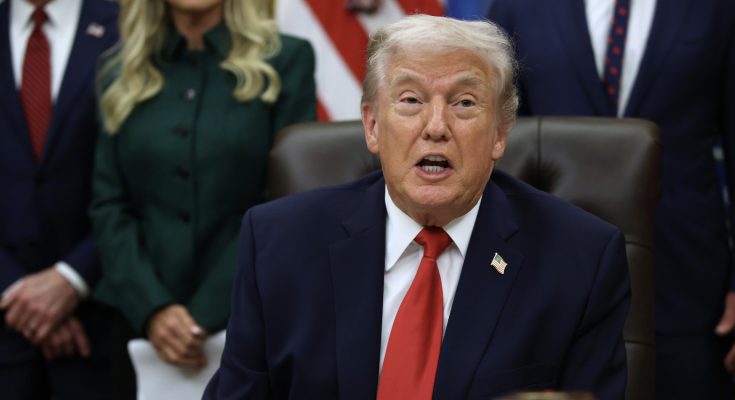
President Donald Trump is sounding off after another bloody and deadly weekend in Chicago.
Fox News Digital has confirmed that six people have died and 39
others have been shot in a series of shootings in the Windy City over the weekend. Chicago police say 13 people were shot in a mass drive-by shooting in Chicago’s Princeton Park neighborhood Friday night. Chicago police: Two suspects opened fire on multiple victims after an SUV drove up on a crowd of people.
“Offenders from inside the vehicle began firing gunshots towards the crowd before fleeing the scene. Multiple victims sustained gunshot wounds and were transported to local hospitals,” CPD said. Chicago Democratic Mayor Brandon Johnson issued a tame response in a post to X regarding the drive-by shooting incident.
“I am heartbroken by the violence in Princeton Park last night. What should have been a night of celebration and community reflection for Juneteenth was shattered by a horrific act of violence. My thoughts and prayers are with the victims and their loved ones,” Johnson wrote.
In a post to Truth Social, President Trump said, “Lots of Killing going on in Chicago. 22 people shot, at least 4 Dead. Why isn’t Governor Pritzker calling me for help. I could make Chicago a safe City in ONE MONTH, in ONE YEAR, it would be one of the safest!!! D.C. went from one of the worst, to one of the safest cities in the U.S. President DJT.”
Soon after Trump’s original post, the official numbers skyrocketed when police released newly compiled data.
Last year, Trump sent hundreds of National Guard troops to Washington, D.C., in an attempt to crack down on crime in our nation’s capital.
All shootings are under investigation, Chicago police say.
Meanwhile, Trump has also been fighting to clean up the streets in Washington, D.C.
At least 13 officials within the Metropolitan Police Department have reportedly been terminated or disciplined following an internal investigation into allegations that department leaders manipulated crime statistics to make Washington, D.C., appear safer than it actually was.
According to reports first detailed by local media and later amplified by lawmakers on the House Oversight Committee, senior police officials allegedly downgraded serious offenses into lesser categories in official reporting systems, reducing the number of violent crimes reflected in public data releases.
The internal probe reportedly resulted in termination notices being issued to Second
District Commander Tatjana Savoy and former Third District Commander Michael Pulliam, along with at least one police captain and numerous additional supervisory officials.
Cmdr. Pulliam had already been suspended last year after allegations surfaced that violent crimes were intentionally reclassified to lower-profile offenses.
Investigators reportedly concluded that the practice was more widespread than initially believed, involving multiple districts and layers of department leadership.
The scandal has become politically explosive because crime statistics in Washington were repeatedly cited by city officials and national Democrats as evidence that public safety conditions were improving, even as residents continued reporting concerns about violent crime, carjackings, robberies, and assaults across the city.
The committee’s earlier report painted a damaging picture of department leadership under former Police Chief Pamela Smith.
According to that report, district commanders told investigators they felt pressure from leadership to “fix” crime numbers and create what lawmakers described as “the perception of low crime in the District.”
The alleged manipulation reportedly focused on reclassifying offenses among the city’s major violent and property crime categories.
Serious assaults, robberies, and other crimes were allegedly downgraded in ways that kept them from appearing in headline public crime statistics.
Critics argue that such practices distort public understanding of crime trends and affect policy decisions, resource allocations, and public trust in law enforcement.
Jeanine Pirro recently revealed that federal prosecutors reviewing cases from the department had upgraded certain assault and firearms charges because suspects appeared to have been undercharged by local authorities.