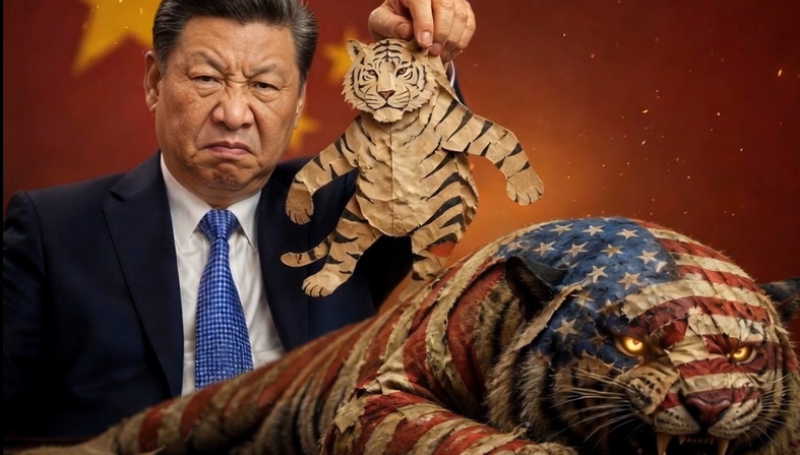
The phrase “paper tiger” has a long and influential history in global politics. It is commonly used to describe a country, leader, or institution that appears powerful and intimidating on the surface but is believed to lack real strength or the ability to follow through on threats. The expression became especially famous during the Cold War when Chinese Communist leader Mao Zedong used it to criticize the United States and other Western powers. Over time, the term evolved into a symbolic political insult that still appears frequently in international debates and geopolitical commentary.
When Chinese officials or state-linked media figures refer to the United States as a “paper tiger,” the statement is usually intended to challenge America’s image as the world’s dominant superpower. The phrase can suggest that the United States may look strong militarily, economically, or diplomatically, but is actually vulnerable, divided, or weaker than it appears. In the context of rising competition between China and the United States over trade, technology, military influence, and global leadership, such language is often designed to project confidence and reinforce China’s political messaging both domestically and internationally.
However, the idea that all Americans become furious over this kind of statement is an exaggeration. Public reactions in the United States are far from uniform, largely because Americans hold very different political opinions and perspectives on foreign policy. Some people interpret the phrase as disrespectful or provocative, particularly those who already view China as a major strategic rival. For these individuals, the remark may feel like a direct challenge to American power, national pride, and international credibility. Media outlets and political commentators may also amplify the controversy, making the statement appear even more dramatic.
At the same time, many Americans view this type of rhetoric as a normal part of international politics. Strong language between competing powers has existed for decades and is often used more for symbolic messaging than for genuine confrontation. Analysts and observers frequently see such comments as political theater aimed at strengthening domestic confidence, signaling determination to allies, or testing the reactions of opponents. In that sense, the phrase “paper tiger” may be less about provoking outrage and more about shaping global narratives.
Ultimately, statements like these reflect the broader strategic rivalry between China and the United States rather than a single emotional response from the American public. While the phrase can attract media attention and fuel debate, reactions across the United States remain diverse, complex, and shaped by individual political beliefs and interpretations of global events.