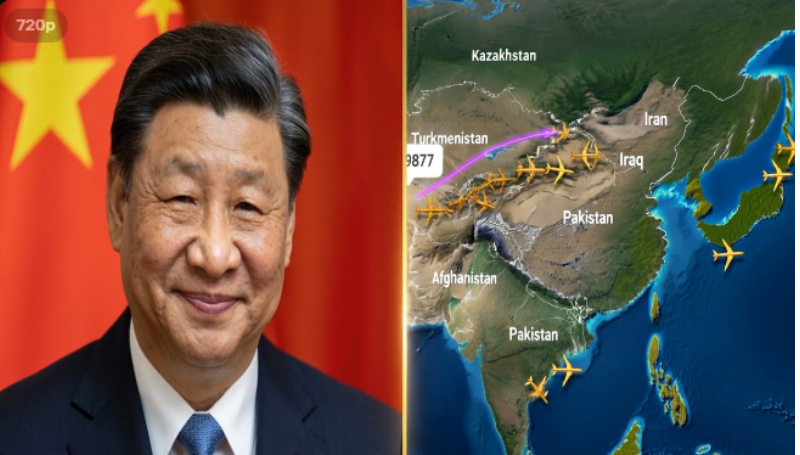
Reports of several cargo aircraft linked to China flying in the direction of Iran before disappearing from public tracking systems have triggered widespread speculation, though the available evidence remains inconclusive.
Flight-tracking data cited by The Telegraph indicates that at least three Boeing 747 freighters departed from Chinese cities on consecutive days—Saturday through Monday—shortly after Israel carried out strikes on Iranian targets. The planes reportedly followed a westward route across northern China, then moved through Central Asian countries including Kazakhstan, Uzbekistan, and Turkmenistan. As they approached Iranian airspace, each aircraft vanished from publicly accessible radar systems, prompting questions about their final destination and the nature of their cargo.Although the filed flight plans listed Luxembourg as the endpoint, the routes taken did not appear consistent with a typical journey to Europe. This discrepancy has raised suspicions among observers, especially given the capabilities of the aircraft involved. Boeing 747 freighters are widely used for transporting large and heavy loads, ranging from industrial machinery to sensitive or high-value cargo, which in some contexts can include military-related materials.The flights have been linked to Cargolux, a Luxembourg-based cargo airline. The company has stated that its aircraft did not enter Iranian airspace but declined to disclose details about what was being transported. This lack of transparency has further fueled speculation, as the absence of cargo information leaves a significant gap in understanding the purpose of the flights. Aviation experts note that aircraft disappearing from public tracking platforms is not necessarily unusual. There are several benign explanations for such occurrences, including gaps in radar coverage, the intentional disabling of transponders, or the use of tracking systems not accessible to the public. In many regions, especially near sensitive or restricted airspace, it is not uncommon for flights to temporarily drop out of view without indicating any improper activity.Nevertheless, the timing and routing of these flights have drawn increased attention due to the broader geopolitical context. China and Iran maintain close strategic and economic ties. Beijing has historically provided Tehran with both civilian and dual-use goods, even as international sanctions have restricted certain types of military cooperation. In return, Iran plays a key role in supplying energy resources to China, reinforcing their partnership.Some analysts have proposed alternative explanations, such as the possibility that Iran is moving critical equipment or materials within its borders in response to rising tensions. However, these interpretations remain speculative and are not supported by confirmed evidence.With hostilities and rhetoric intensifying between Israel and Iran-aligned groups, unusual patterns in air traffic are likely to attract scrutiny. For now, the true nature and purpose of these flights remain unclear, highlighting the importance of relying on verified information rather than conjecture.