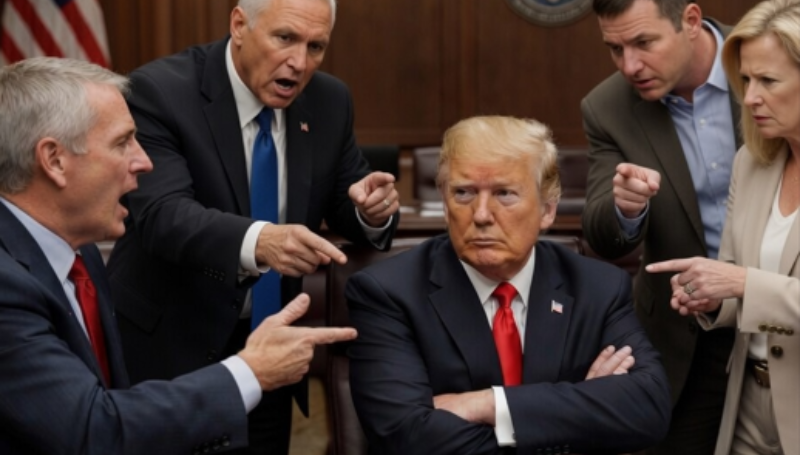
Recent comments attributed to Senator Ed Markey have brought renewed public attention to the 25th Amendment of the United States Constitution, a legal mechanism designed to address situations in which a president may be unable to fulfill the duties of office. Although a small number of lawmakers have raised similar concerns in broader political discussions, there has been no formal invocation of the amendment, and analysts generally describe the situation as part of ongoing political debate rather than an active constitutional process.
The 25th Amendment, ratified in 1967, was created to clarify presidential succession and to establish procedures for dealing with presidential incapacity. One of its key provisions outlines how presidential powers can be transferred if a president is considered unable to perform official responsibilities. This process begins when the vice president, together with a majority of the principal officers of the executive departments—commonly understood as the Cabinet—submits a written declaration stating that the president is unfit to continue in office.
Once this declaration is made, the vice president immediately assumes the role of acting president. However, the process is not necessarily permanent or uncontested. If the president disputes the declaration, the matter is sent to Congress for resolution. At that stage, Congress must consider whether to uphold the transfer of power, requiring a two-thirds majority vote in both the House of Representatives and the Senate to confirm the removal or continued displacement of the president.
This high threshold reflects the framers’ intent to ensure that the amendment cannot be used lightly or for partisan advantage. As a result, the 25th Amendment is considered a safeguard of last resort, reserved for extraordinary circumstances involving clear incapacity.
Despite its importance in constitutional law, the amendment has never been used to remove a sitting president from office. It has, however, been used in limited, temporary situations, such as when presidents briefly transferred authority during medical procedures requiring anesthesia, with power returned afterward.
The renewed discussion surrounding the amendment highlights broader questions about governance, accountability, and institutional checks and balances in the United States. Legal experts note that while such conversations often intensify during politically sensitive periods, the actual implementation of the amendment would require an unusual level of agreement among top executive officials and a significant bipartisan consensus in Congress.
Overall, most analysts view the likelihood of the amendment being invoked in the near future as low, emphasizing that current discourse reflects political rhetoric more than an imminent constitutional action.