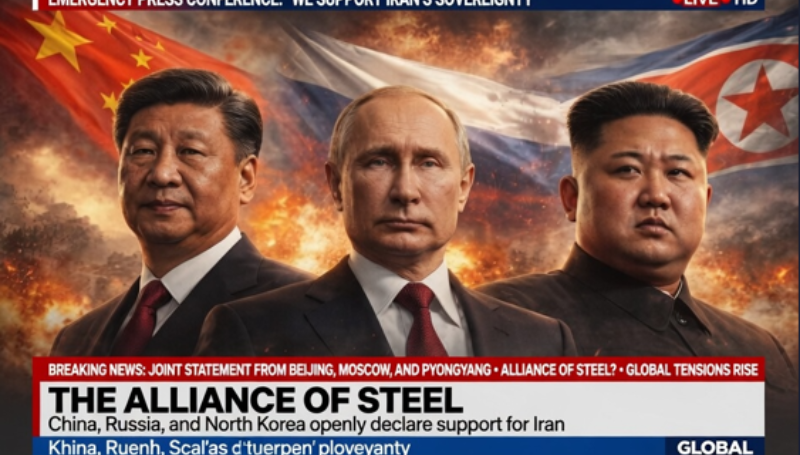
Global geopolitical tensions are rising after Western nations accused China, Russia, and North Korea of offering support to Iran amid the escalating conflict in the Middle East. The allegations have added a new layer of complexity to an already volatile situation, drawing attention to the role of major world powers in regional disputes.
In response, the three countries have strongly denied the accusations and criticized them as politically motivated. Officials from Beijing, Moscow, and Pyongyang argue that such claims are part of a broader effort by Western governments to exert pressure on nations that do not align with their policies. They maintain that their positions are being misrepresented in order to justify increased scrutiny and influence over global affairs.
Leaders and representatives from these nations have emphasized that their stance toward Iran is guided by principles of national sovereignty and non-interference. They stress that every country has the right to determine its own political direction without external intervention. This message has been repeated across various international platforms, reflecting a consistent narrative that challenges Western approaches to foreign policy, particularly in conflict zones.
Experts suggest that these developments highlight a growing alignment among countries seeking to counterbalance Western influence. While China and Russia have long advocated for a multipolar global order, North Korea has also echoed similar sentiments, often criticizing sanctions and military actions led by the United States and its allies. Although these countries do not form a formal alliance, their shared positions on issues like Iran indicate a convergence of strategic interests.
The situation further complicates the conflict in the Middle East, transforming it into a broader geopolitical issue. As global powers become more involved—whether through rhetoric, diplomacy, or indirect support—the risk of escalation increases. What began as a regional conflict now carries implications for international stability, as competing visions of global leadership and governance come into sharper focus.
Overall, the responses from China, Russia, and North Korea illustrate the deepening divisions in global politics. Their rejection of the accusations and emphasis on sovereignty signal an ongoing shift toward a more contested and multipolar international landscape, where major powers increasingly challenge each other’s influence and narratives.