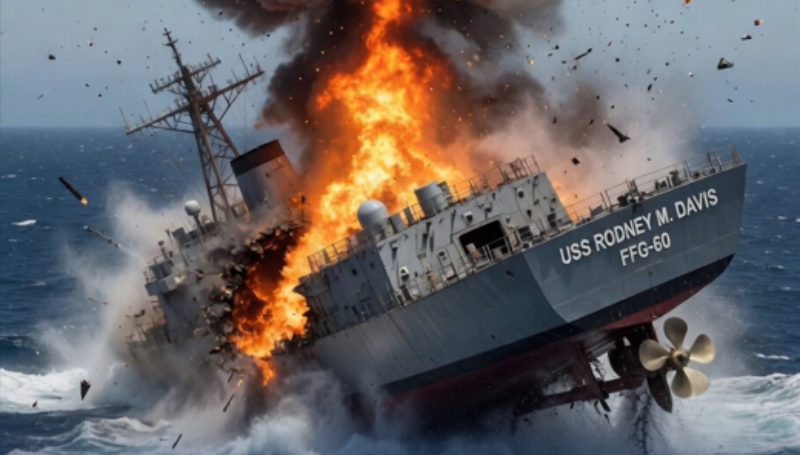
The decommissioned USS Rodney M. Davis (FFG-60), once a guided-missile frigate in the United States Navy, was ultimately sunk in a planned SINKEX (sinking exercise), marking the end of its long operational life. Rather than being lost in combat, the vessel’s final mission was carefully coordinated as part of a training and weapons evaluation exercise. During the event, the ship was struck by an AGM-84 Harpoon anti-ship missile, which successfully hit its target and led to the vessel’s sinking.
Commissioned in 1982, the USS Rodney M. Davis belonged to the Oliver Hazard Perry-class of frigates, a group of ships developed during the Cold War. These vessels were designed primarily for anti-submarine warfare and escort duties, playing a vital role in protecting larger naval assets such as aircraft carriers and supply ships. The frigate was named in honor of Rodney Maxwell Davis, a U.S. Marine Corps sergeant who received the Medal of Honor for his actions during the Vietnam War. His legacy gave the ship added symbolic importance throughout its years of service.
Over the decades, the USS Rodney M. Davis participated in a wide range of missions, including patrol operations, multinational exercises, and maritime security efforts. Its deployments took it across multiple regions, where it contributed to maintaining stability and supporting allied forces. Like many ships of its class, it served as a dependable workhorse within the fleet.
Before the sinking exercise took place, the Navy ensured that the vessel was properly prepared in accordance with environmental and safety regulations. Hazardous substances, fuels, and sensitive materials were removed to reduce environmental impact and eliminate potential risks. Once cleared, the ship was designated as a live-fire target, allowing military personnel to observe real-world weapon effects.
The controlled sinking provided valuable data for naval planners and engineers. By studying how the missile impacted and ultimately destroyed the ship, analysts gained insights into weapon performance and structural resilience. Although the event carried emotional significance for former crew members, it served an important role in advancing naval capabilities and improving future operational readiness.