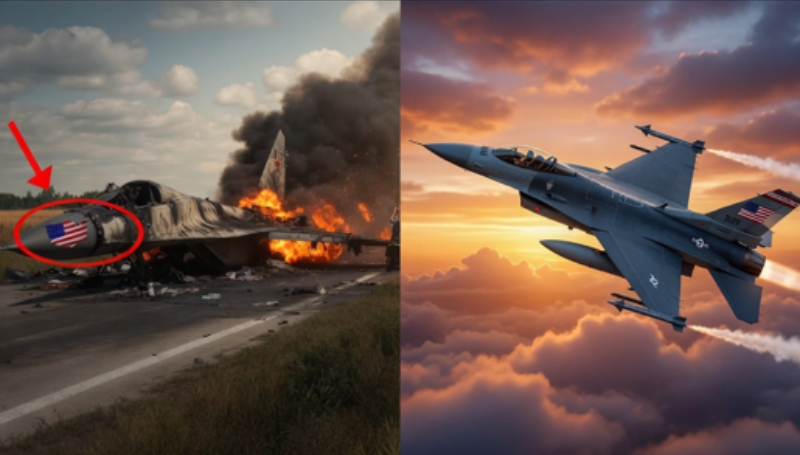
Captain Alex Mercer stood at the edge of the airbase, the cold evening wind cutting sharply across the runway. The sky was dimming into deep shades of orange and gray, as if the horizon itself sensed what was about to unfold. Around him, the base remained unusually quiet—no celebration, no noise, only the heavy expectation of something irreversible.
This was not a routine mission. It was a high-stakes aerial engagement that symbolized rising global tension, where each decision carried consequences far beyond the cockpit.
On the opposite side of the operation, Sergeant Ivan Petrov of the Russian Air Force ran final checks on his MiG-29. He had trained for years, preparing for moments like this, yet nothing in training could fully prepare him for the weight pressing on his mind. As he climbed into the cockpit, discipline fought against unease. He was not just flying for duty—he was flying for identity, for purpose, for everything he believed he represented.
Engines roared across the airfield almost in unison. Mercer entered his F-16, the vibration of the aircraft syncing with his racing heartbeat. Orders were clear: identify, engage, and dominate. But clarity on paper felt far less certain in reality. As he looked into the darkening sky, he wondered how control could ever truly belong to anyone up there.
Both jets lifted into the sky, disappearing into scattered clouds. Petrov ascended with precision, guided by training and conviction. Mercer followed through instrumentation and instinct, tracking signals that brought the two aircraft closer with every passing second.
When radar contact confirmed proximity, time seemed to compress. The sky transformed into a shifting field of speed, reaction, and calculated movement. Each pilot responded instantly, mirroring the other’s maneuvers with near-equal skill. It was not chaos—it was controlled intensity, a deadly balance held together by discipline.
But beneath the technical precision, something human began to surface. Mercer felt it first: a quiet question about purpose. Petrov felt it too, a growing awareness that the “enemy” was not distant or abstract, but another person bound by similar duty and pressure.
As they closed in once more, the moment reached its breaking point. Then, unexpectedly, Petrov broke formation, choosing evasive disengagement instead of continuation. Mercer hesitated, caught between instinct and understanding, before following suit.
The tension dissolved. No explosion followed, no final strike—only separation.
They flew away in opposite directions, leaving behind not victory or defeat, but reflection. In that silence above the clouds, both pilots understood something rare in war: that choosing not to continue can sometimes be the most difficult and meaningful decision of all.