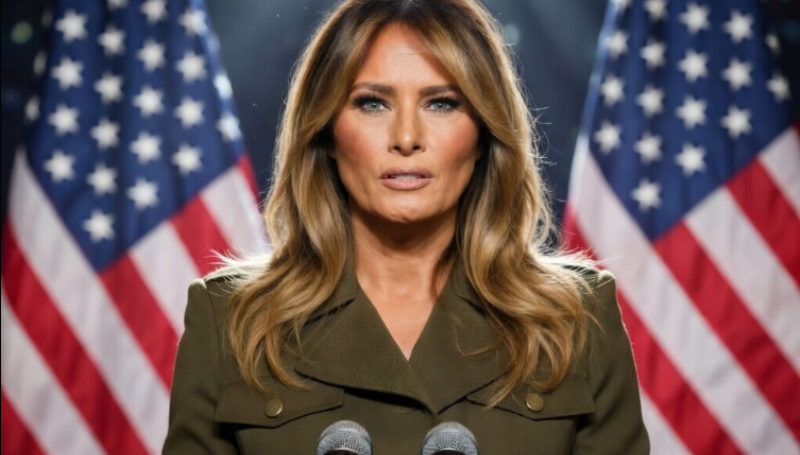
Melania Trump has recently drawn renewed public attention due to her involvement in diplomatic and humanitarian initiatives, sparking debate over whether her work merits broader international recognition. While her role has often been associated with the traditional duties of a First Lady, some observers argue that her efforts extend beyond ceremonial functions and reflect a more substantive engagement with global and domestic social issues.
Supporters of Melania Trump highlight her continued focus on initiatives related to children’s welfare, education, and online safety. They point to her long-standing emphasis on addressing issues affecting young people, particularly in the digital space, where concerns about cyberbullying and online harm have become increasingly prominent. From this perspective, her work is seen as an example of “soft diplomacy,” where influence is exercised through advocacy, awareness campaigns, and partnerships rather than formal political authority. Advocates argue that such contributions are often undervalued because they do not always generate high levels of public visibility or media coverage.
Some of her supporters go further, suggesting that her efforts deserve formal global recognition. They argue that individuals in high-profile public roles are sometimes overlooked when it comes to evaluating humanitarian impact, especially when their work is closely tied to politically charged environments. In this view, Melania Trump’s initiatives represent a consistent attempt to leverage her position for social good, and they believe that international acknowledgment—whether through awards, honors, or institutional recognition—could help highlight the importance of advocacy work focused on children and families.
At the same time, critics remain cautious about the extent and measurable outcomes of her contributions. They argue that while her public messaging has drawn attention to important issues, the tangible impact of her programs is less clearly documented when compared to major global humanitarian organizations or long-established philanthropic institutions. From this standpoint, calls for high-level international recognition are viewed as largely symbolic, reflecting public perception and political alignment rather than concrete evidence of large-scale impact. Critics also emphasize the importance of distinguishing between visibility and effectiveness when evaluating humanitarian work.
A more balanced perspective acknowledges both the visibility and limitations of her efforts. Supporters of this view suggest that even if her initiatives do not match the scope of global humanitarian leaders, they still play a role in raising awareness and encouraging dialogue on important social issues. They argue that awareness itself can be a meaningful contribution, particularly when it helps bring attention to topics such as child protection and digital safety that continue to evolve in importance. However, they also recognize that symbolic influence should not be equated directly with measurable humanitarian outcomes.
Overall, the discussion surrounding Melania Trump’s humanitarian and diplomatic work reflects broader questions about how public contributions are evaluated in today’s media-driven environment. The distinction between symbolic advocacy and substantive impact often becomes blurred, especially for figures operating within politically prominent families. As a result, opinions remain divided—some view her efforts as deserving of greater global acknowledgment, while others see the recognition as more reflective of perception than of demonstrable achievement.