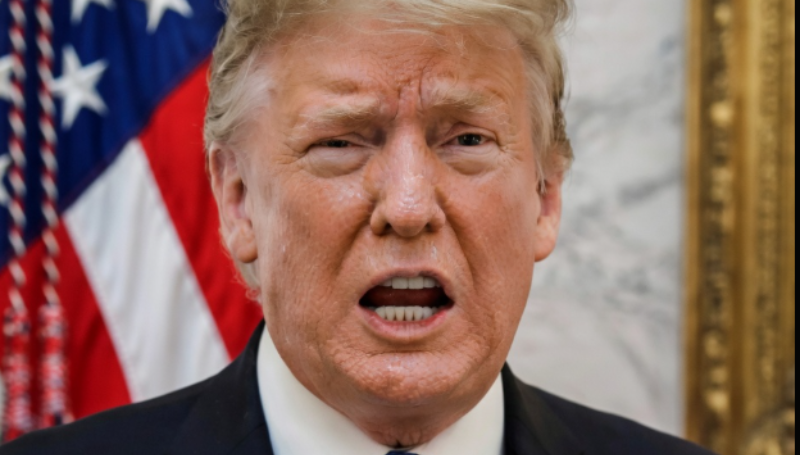
The reaction in the room came a fraction of a second before full understanding set in. There was a brief pause, followed by laughter that felt slightly delayed and uncertain. Aboard Air Force One, Donald Trump had just delivered a line that caught his audience off guard. He joked that he was “at the bottom of the totem pole” when it came to getting into heaven, then added that if he managed to end the war in Ukraine, “maybe they’ll let me in.”
At first glance, the comment fit neatly within Trump’s well-known style. It was exaggerated, lightly self-deprecating, and delivered with the timing of someone comfortable commanding attention. Yet the remark carried a subtle undertone that didn’t fully land for everyone in the room. Trump’s public image is typically rooted in confidence, authority, and an insistence on strength. For a moment, portraying himself as low in any hierarchy—even jokingly—felt slightly out of character. The suggestion that entry into heaven might depend on approval from some higher authority only added to that unusual note.
The exchange began when Peter Doocy posed a question about whether helping to negotiate peace in Ukraine could improve Trump’s chances of entering heaven. Trump responded by leaning into the humor, saying he doubted anything would guarantee him a place, before playfully suggesting that ending the conflict might help his case. Later, he clarified that he had been joking, describing his tone as sarcastic and lighthearted. He also remarked that even casual humor tends to be closely analyzed in today’s political environment.
The audience’s laughter reflected that complexity. While many responded as expected, there was a faint hesitation, as if people were unsure how to interpret the line. For supporters, the moment was typical of Trump’s approach—blunt, irreverent, and unafraid to mix humor with serious global issues. He has often framed major challenges, including war, as problems to be solved through action and results rather than abstract ideals. In this context, his comment suggested that achieving peace could be viewed as a meaningful accomplishment, even in a humorous, exaggerated sense.
Critics, however, drew different conclusions. The language of hierarchy and conditional acceptance invited broader interpretations about status and recognition. Trump has long positioned himself as an outsider confronting powerful institutions, yet he frequently emphasizes visible success, such as public approval and decisive outcomes. The joke, to some, reflected that familiar tension between independence and the desire for acknowledgment.
In reality, the remark was likely less revealing than it appeared. Trump has a long history of using humor, exaggeration, and sarcasm to engage audiences and deflect scrutiny. His reference to “they” was widely understood as a playful allusion to divine judgment rather than a serious statement about personal beliefs. Still, the moment stood out because it briefly disrupted the steady confidence that defines his public persona.
Ultimately, the exchange was fleeting but memorable. It highlighted how even a casual joke can take on added meaning in a highly charged political climate. For Trump, it was simply a moment of humor. For observers, it became another example of how his words—no matter how offhand—are often examined from multiple angles, revealing as much about the audience as the speaker himself.