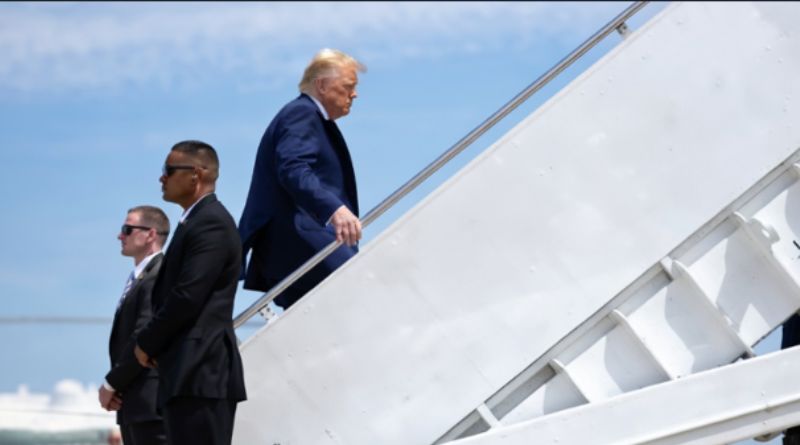
President Donald Trump and First Lady Melania Trump encountered a brief travel disruption during their visit to the United Kingdom when their helicopter, Marine One, was forced to make a precautionary landing due to a technical concern.
Press Secretary Karoline Leavitt said the aircraft experienced a hydraulics issue while en route. “Out of an abundance of caution, the pilots landed at a local airfield before reaching Stansted Airport,” she told reporters. The president and first lady were then safely transferred to a backup helicopter, allowing them to complete their journey without further incident.
The flight had originally been scheduled to take about 20 minutes, traveling from the prime minister’s Chequers residence to Stansted Airport. However, due to the unexpected landing and transfer, the trip ultimately lasted closer to 40 minutes. Officials emphasized that the situation was handled according to safety protocols and did not pose a serious threat.
The incident occurred amid a high-profile diplomatic visit, as King Charles III and Queen Camilla hosted the Trumps for what has been described as an unusual second state visit. The trip focused heavily on strengthening economic cooperation and reinforcing strategic ties between the United States and the United Kingdom.
Earlier in the visit, Prime Minister Keir Starmer highlighted a proposed £250 billion joint investment initiative, describing the U.S.-U.K. partnership as the “most natural partnership in the world.” The plan is intended to expand collaboration across multiple sectors, including technology, energy, and defense.
President Trump’s itinerary included a meeting with King Charles III at Windsor Castle, followed by travel to Chequers for discussions with Prime Minister Starmer. Their private talks reportedly covered a range of international issues, including the war in Ukraine, the conflict in Gaza, environmental challenges, and questions surrounding free speech.
The two leaders also met with business executives during a reception aimed at promoting economic cooperation. Starmer referred to the emerging framework as a “tech-prosperity deal,” while Trump emphasized its potential to generate significant economic benefits. He stated that the agreement could create “billions of dollars in opportunities” and improve U.S. access to the United Kingdom’s globally competitive aerospace sector.
A key focus of the agreement is collaboration in advanced technologies. Areas of cooperation include artificial intelligence, quantum computing, nuclear energy, fusion research, and next-generation telecommunications such as 6G. Trump stressed that innovation, supported by regulatory reform, would be central to the partnership’s success.
According to the president, the broader initiative has already encouraged more than $350 billion in private sector commitments. Among the most notable investments is a reported $136 billion contribution led by Blackstone.
Energy development also plays a major role in the plan. Trump highlighted a partnership between U.S.-based X Energy and the UK’s Centrica to deploy small modular nuclear reactors across Britain. The project is expected to generate over $50 billion in economic value, create thousands of jobs, and provide electricity to approximately 1.5 million homes.
Referencing the legacy of British mathematician Alan Turing, Trump noted that the agreement aims to position both nations at the forefront of artificial intelligence. He emphasized that reliable energy supplies would be essential to sustaining rapid technological advancement.
The president concluded his overseas trip and returned to the White House on Friday following the series of meetings and engagements.