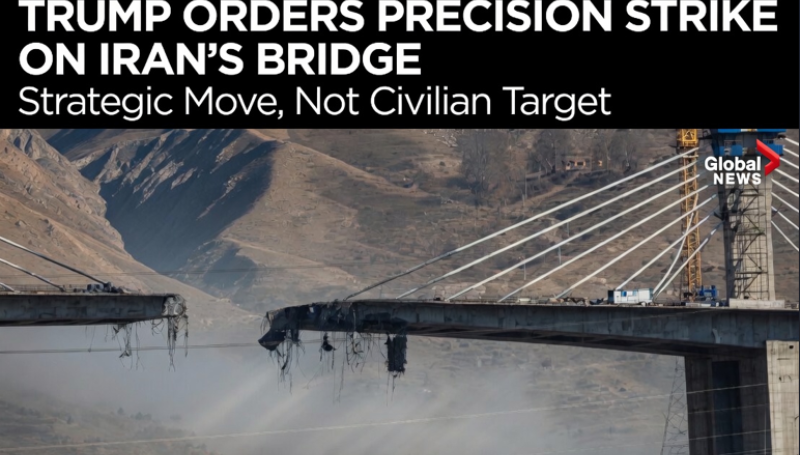
In a development that has drawn widespread international attention, former U.S. President Donald Trump reportedly authorized a precision strike on a partially constructed bridge near Karaj. The structure, which connects Karaj to the capital, Tehran, was believed to have potential strategic value, though details surrounding its exact use remain contested.
According to various reports, the bridge was not yet open to civilian traffic at the time of the strike. Some sources claim it was being utilized, or was intended to be used, by Iran’s military forces, including the Islamic Revolutionary Guard Corps, for logistical purposes such as transporting equipment and personnel. If accurate, this could make it a target of military interest. However, independent verification of these claims has not been fully established.
The strike resulted in reported casualties, with Iranian state media citing eight fatalities and approximately 100 injuries. While officials and some analysts argue that the operation was designed to limit collateral damage, the presence of casualties has raised concerns about the proportionality and precision of the attack. As with many incidents involving dual-use infrastructure, questions remain about whether the target was strictly military in nature or also served potential civilian functions.
Under international humanitarian law, including principles outlined in the Geneva Conventions, attacks must distinguish between civilian and military objectives and avoid excessive harm to civilians relative to the anticipated military advantage. Legal experts note that determining whether these standards were met would depend on classified intelligence, operational intent, and the circumstances at the time of the strike.
The incident occurs against a backdrop of longstanding tensions between the United States and Iran, particularly over Iran’s missile development and regional military activities. While targeting logistical infrastructure is a recognized military tactic, conducting such a strike within Iranian territory represents a significant escalation and carries potential geopolitical consequences.
International reaction has been mixed. Some observers view the strike as a calculated attempt to disrupt military capabilities and signal deterrence, while others warn it could heighten regional instability and provoke retaliation. The situation underscores the complexity of modern conflict, where strategic objectives, legal considerations, and humanitarian concerns often intersect.