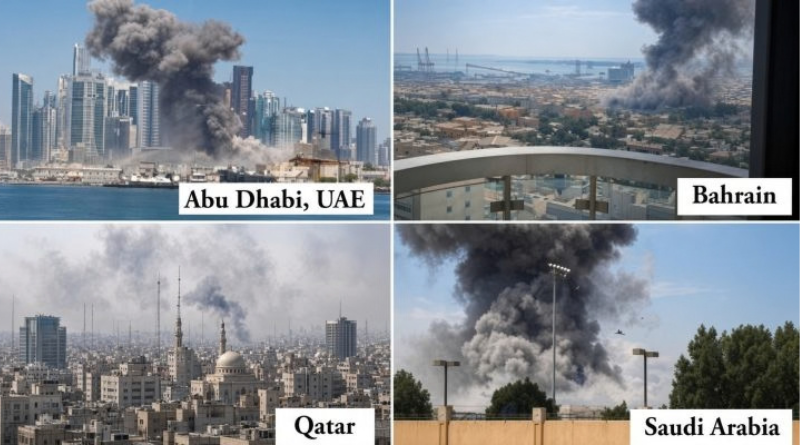
PERSIAN GULF — Tensions across the Middle East have continued to intensify as the conflict involving Iran, the United States and regional actors increasingly affects military installations, commercial shipping and critical energy infrastructure across the Persian Gulf.
Bahrain, Qatar, Kuwait and the United Arab Emirates remain particularly exposed because of their strategic locations and their hosting of major U.S. military facilities. The continuing confrontation has placed governments across the Gulf on heightened alert while raising concerns about the potential for further attacks and disruptions to one of the world’s most important energy corridors.
The escalation is no longer limited to missile and drone threats. Maritime attacks around the Strait of Hormuz have become a growing concern, with Reuters reporting that the week ending October 5 recorded the highest number of tanker-related incidents since the war began in February. At least 12 attacks, attempted attacks or other hostile incidents were recorded between September 28 and October 5.
UAE Maintains Heightened Security
The United Arab Emirates remains a critical part of the regional security picture because of its proximity to the Strait of Hormuz and its role in supporting U.S. military operations.
Al Dhafra Air Base near Abu Dhabi has long been an important U.S.-linked military installation. Previous Iranian attacks and threats against facilities associated with American forces have demonstrated the risks faced by Gulf states that host foreign military personnel.
The UAE’s extensive air-defense network provides protection against missiles and drones, but the scale of the potential threat remains difficult to manage. Military bases are not the only facilities at risk. Airports, energy installations, ports and densely populated areas can all be affected by regional fighting.
The possibility of simultaneous attacks from different directions creates additional challenges for defense planners, particularly when drones and missiles are used together.
Bahrain Remains on the Front Line
Bahrain occupies an especially important position because it hosts the headquarters of the U.S. Navy’s Fifth Fleet.
The American naval presence makes Bahrain a central hub for maritime operations throughout the Gulf, the Arabian Sea and surrounding waters. That strategic role also makes facilities associated with U.S. forces potential targets during periods of direct confrontation with Iran.
The island nation’s limited geographic size presents an additional challenge. Any attack near a military installation can have consequences for surrounding civilian communities, transportation networks and other critical infrastructure.
Previous Iranian attacks have included missile and drone activity directed toward Kuwait and other Gulf locations. In May, for example, CENTCOM said Iran launched a ballistic missile toward Kuwait that was intercepted by Kuwaiti forces, while U.S. forces intercepted Iranian drones near the Strait of Hormuz.
Qatar Faces Risks Around Al Udeid
Qatar also occupies a central position in the regional military landscape because of Al Udeid Air Base, a major U.S. installation supporting operations throughout the Middle East.
Any significant attack affecting the base could have consequences beyond Qatar itself because of the facility’s role in U.S. military logistics and command operations.
For Doha, the challenge is therefore twofold: protecting its territory and population while maintaining essential military and economic infrastructure during a period of regional instability.
The broader conflict has demonstrated how quickly military developments involving Iran and the United States can affect neighboring countries that host American forces.
Kuwait Caught Between Military and Economic Pressures
Kuwait has also faced security concerns because of its proximity to Iran and the presence of U.S. military infrastructure.
Missile and drone threats in the region have forced Gulf governments to maintain heightened readiness while attempting to protect civilian populations and critical facilities.
For Kuwait and its neighbors, the consequences of the conflict extend beyond direct physical attacks. Aviation, shipping, insurance costs and energy markets can all be affected when military activity increases around the Gulf.
Hormuz Becomes the Central Pressure Point
The Strait of Hormuz remains at the center of the crisis.
The waterway historically carries a substantial share of global oil and liquefied natural gas shipments, making any prolonged disruption a concern for energy-importing countries worldwide.
Recent data show that maritime traffic has fallen sharply. Reuters reported that only seven commodity vessels passed through the strait on October 6, the lowest daily total in more than two months. Crude oil flows through the waterway fell to approximately 10.1 million barrels per day, around 74% of pre-war levels.
At the same time, alternative export routes and increased shipments elsewhere in the region have helped offset some of the disruption.
Nevertheless, the risks remain substantial. Oil prices have moved above $100 a barrel as attacks on tankers and concerns about future supply continue to unsettle global markets.
U.S. Military Operations Continue
The United States has also continued military operations against Iranian targets.
CENTCOM has reported repeated strikes against Iranian missile and drone facilities, maritime capabilities, air-defense systems, command centers and logistics infrastructure. In July, CENTCOM said more than 50,000 U.S. service members were operating across the Middle East.
Those operations have been presented by Washington as efforts to protect American forces and commercial shipping. Iran, meanwhile, has continued to demonstrate its ability to threaten military and maritime targets across the region.
The result is a security environment in which Gulf governments must simultaneously prepare for missile and drone attacks, protect critical infrastructure and keep commercial trade moving.
A Region Under Growing Pressure
The continuing confrontation has transformed the Persian Gulf into a major security flashpoint with consequences extending well beyond the region.
For Bahrain, Qatar, Kuwait and the UAE, the immediate priority remains protecting their populations and infrastructure while avoiding further escalation. For Washington and Tehran, the central challenge is preventing military retaliation from developing into an even broader regional conflict.
With tanker attacks increasing and traffic through the Strait of Hormuz declining, the consequences are increasingly visible in global energy markets and commercial shipping.
As military forces remain on alert and diplomatic uncertainty persists, governments throughout the Gulf are closely monitoring the skies, military installations and shipping lanes. The coming weeks will be critical in determining whether the region moves toward greater stability—or another cycle of escalation.