New reporting has revealed just how seriously the Trump administration took a credible assassination threat from Iran last month, going so far as to move President Donald Trump between aircraft in an airport catering truck to disguise his true departure route from the NATO summit in Turkey. Far from a curious footnote, the episode underscores the very real dangers the president continues to face as a result of his administration’s decisive action against Iran’s nuclear ambitions.
According to reports first published by The Washington Post and later corroborated by The New York Times and Reuters, the operation took place on July 8 at Ankara’s Esenboğa Airport following Trump’s participation in the NATO leaders summit. The White House had publicly stated that the president would depart Turkey aboard the primary presidential aircraft. What actually happened was far more elaborate and far more necessary given the threat environment.
Trump had arrived in Ankara aboard a newly renovated Boeing 747-8, the aircraft donated to the United States by Qatar and recently upgraded for presidential use. That plane’s first international trip already drew scrutiny over its cost and security posture. As tensions with Iran escalated following renewed American military strikes, intelligence officials reportedly identified a specific and credible threat targeting the president’s movements, prompting a decision not to use the newer aircraft for the return leg of the trip.
Instead, Trump announced on Truth Social that he would use an older Air Force One plane, the familiar baby blue jet, for what he described as old time’s sake, while the newer Qatari donated aircraft would make a separate stop at RAF Mildenhall in the United Kingdom so that American service members stationed there could tour it. On its face, this appeared to be a simple, sentimental scheduling decision. It was, in reality, the first layer of a security deception operation.
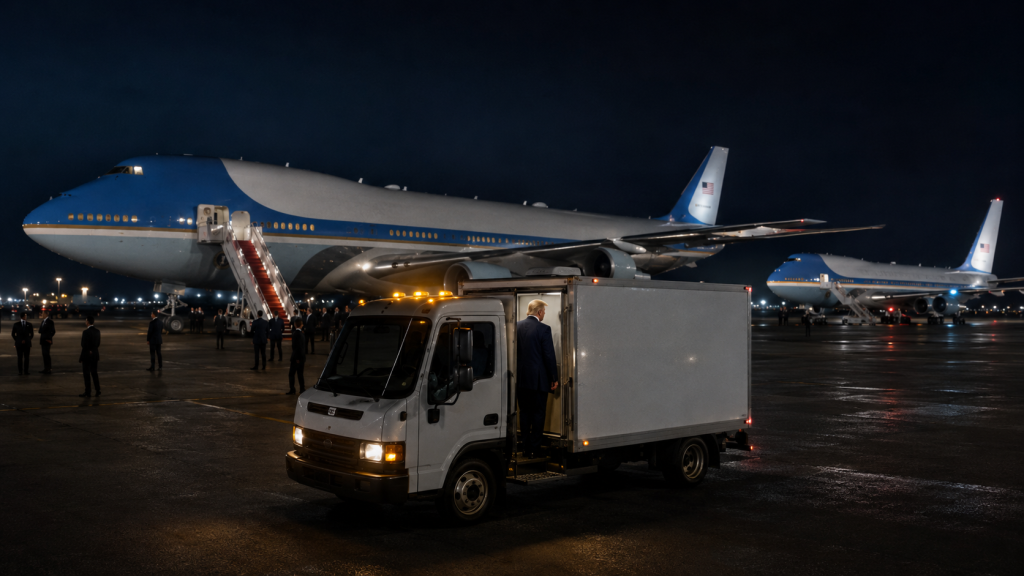
Television cameras captured Trump boarding the older Air Force One in full public view, exactly as the White House had announced. Moments later, according to the reporting, he quietly exited the aircraft through a door on the far side of the plane, out of view of the media, and was moved into an airport catering truck, the kind of service vehicle ordinarily used to load meals and supplies onto commercial and military aircraft.
The catering truck then carried the president across the tarmac to a smaller aircraft, a U.S. Air Force C-32A, a military transport variant of the Boeing 757. Trump boarded that aircraft in secret, while the original Air Force One, now serving as a high-visibility decoy, prepared to take off with accompanying staff and traveling press on board, many of whom reportedly believed the president was still with them.
In one of the more striking details to emerge, reporters aboard the decoy aircraft were instructed by staff to keep their cabin window shades tightly closed for the duration of the flight, a highly unusual request that only added to the sense that something out of the ordinary was underway. When journalists later asked Trump directly about the closed shades, he offered a characteristically blunt explanation, telling them they were probably on a dangerous flight, but that if he goes, they go too.
That remark, equal parts candid and reassuring, speaks to the seriousness with which the administration treated the threat. This was not a routine security precaution taken out of excessive caution. It was a response to specific intelligence about a plot against the president’s life, and the White House chose to protect not only Trump but the staff and journalists traveling with him by keeping the decoy flight as convincing as possible.
Both aircraft, the decoy Air Force One carrying staff and press, and the smaller C-32A secretly carrying the president, flew in tandem toward RAF Mildenhall in Suffolk, England, arriving within minutes of one another at around 10:20 p.m. local time. Once on the ground, Trump was quietly transferred back onto the primary presidential jet without detection before stepping off the aircraft to greet the American military personnel and members of the media waiting on the tarmac, as though nothing unusual had occurred.
The scale of coordination required to pull off such a maneuver, moving the sitting president of the United States between three separate aircraft across two countries while keeping the operation concealed from most of the traveling press corps, speaks to the professionalism of the Secret Service and military personnel involved. It also speaks to just how seriously the threat from Iran was taken at the highest levels of the government.
The timing of the threat is significant. The maneuver took place the night after the United States resumed military strikes on Iranian targets, following a breakdown in diplomatic talks between Washington and Tehran. Trump has previously stated publicly that he believes he is Iran’s number one target, a claim that, given this newly reported security operation, appears to have been treated as a literal operational reality by his protective detail rather than mere rhetorical flourish.
It is worth pausing on the broader context here. This deception operation followed a period of renewed hostilities with Iran after the regime’s continued destabilizing behavior in the region led the administration to authorize fresh strikes on Iranian military and nuclear-related targets. Threats against American leadership are an unfortunately predictable response from a regime that has spent decades sponsoring terrorism and openly calling for the destruction of American allies.
Unhinged liberals may attempt to spin this story as evidence of chaos or excessive secrecy within the White House. That reading misses the point entirely. What the reporting actually documents is a well-executed, multi-layered security response to a specific and credible threat against the life of the sitting president of the United States, carried out with minimal disruption to the broader diplomatic mission in Ankara.
It is also worth noting that this kind of decoy operation, while dramatic in its details, is not without precedent in the history of presidential security. Past administrations have employed similar tactics, including body doubles, decoy motorcades, and last-minute route changes, when credible threats warranted it. What makes this instance notable is simply the level of detail now available to the public, thanks to reporting that pieced together the operation from officials and reviewed material.
The White House has not offered an extensive public comment disputing the substance of the reporting, and the consistency of the accounts across the Washington Post, New York Times, and Reuters, each citing separate sourcing, lends credibility to the narrative. Photographs and video circulating from the scene, including images of a catering truck visible alongside Air Force One on the tarmac minutes after Trump had boarded, further corroborate the timeline described in these reports.