BREAKING: Marine One Carrying Trump and Melania Forced Into Emergency Landing in Britain
For a moment, the carefully choreographed presidential visit to Britain took an unexpected turn.
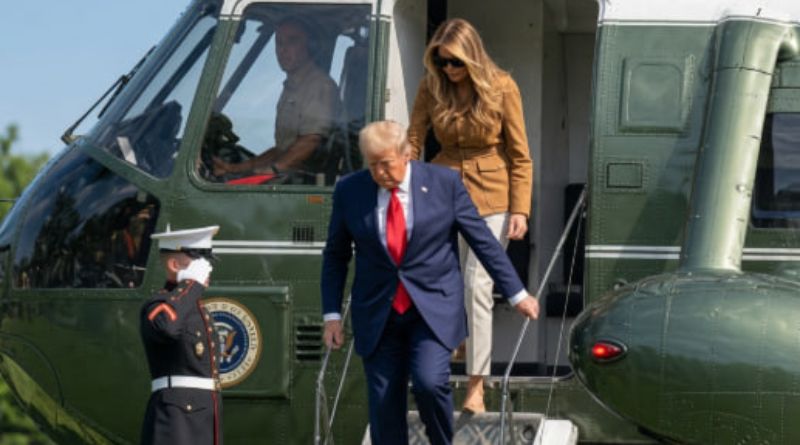
President Donald Trump and First Lady Melania Trump were aboard Marine One when the helicopter was forced to make an emergency landing after pilots detected a hydraulics issue.
According to White House Press Secretary Karoline Leavitt, the pilots made the decision to land at a local airfield “out of an abundance of caution” before the helicopter could reach Stansted Airport.
Trump and Melania were not left stranded.
They were quickly transferred to a support helicopter and continued their journey safely.
But what was supposed to be a routine 20-minute flight from Prime Minister Keir Starmer’s Chequers landing zone to Stansted turned into a journey lasting nearly 40 minutes.
The incident unfolded during one of the most closely watched moments of Trump’s trip to the United Kingdom.
And behind the scenes, the president was engaged in talks about something potentially far bigger than the helicopter scare.
A SECOND STATE VISIT — AND A MASSIVE U.S.-U.K. DEAL
Trump and Melania were in Britain for an unusual second state visit, hosted by King Charles III and Queen Camilla.
The visit was centered not only on diplomacy, but on a massive economic relationship between Washington and London.
Prime Minister Keir Starmer praised a reported £250 billion mutual investment package, describing the U.S.-U.K. relationship as one of the most natural partnerships in the world.
Earlier in the day, Trump had spent time at Windsor Castle with King Charles III before traveling to Chequers, the prime minister’s country residence.
There, politics, business and technology dominated the agenda.
The private discussions reportedly touched on major international issues, including Ukraine, Gaza, the environment and free speech.
But the economic announcement quickly became one of the defining moments of the visit.
Starmer called the agreement a “tech-prosperity deal.”
Trump said it would create billions of dollars in opportunities for American businesses while giving the United States greater access to Britain’s aerospace supply chain.
And then came the bigger vision.
Artificial intelligence.
Quantum computing.
Fusion energy.
6G.
Civil nuclear power.
Trump described the new agreement as a historic expansion of cooperation between the two nations, saying deregulation and innovation could unlock an enormous wave of investment.
He also highlighted private-sector deals reportedly worth more than $350 billion, including a major investment from Blackstone.
But perhaps the most striking announcement involved nuclear energy.
American company X-energy and British company Centrica have been working toward deploying advanced modular nuclear reactors across the United Kingdom.
Trump said the project could generate more than $50 billion in economic value, create up to 2,500 jobs, and provide power for approximately 1.5 million homes.
And the president emphasized one point repeatedly:
Artificial intelligence needs enormous amounts of energy.
As AI races forward, the competition is no longer simply about computer chips, software or data.
It is increasingly about electricity.
Massive amounts of it.
And Trump argued that the United States and Britain will need to build the energy infrastructure capable of powering that technological future.
FROM A HELICOPTER SCARE TO A GLOBAL PARTNERSHIP
The emergency landing briefly interrupted the president’s journey.
But it did not derail the broader mission.
By the end of the visit, the message from Washington and London was clear:
The historic alliance between the United States and Britain is being pushed into a new era — one increasingly defined by technology, energy, investment and strategic cooperation.
And after days of meetings, ceremonies and negotiations, Trump returned to the White House Friday.
A routine presidential flight had suddenly become an unexpected headline.
But the larger story was much bigger than Marine One.
It was about two longtime allies betting heavily on the technologies — and the energy — that could shape the next generation of the global economy.