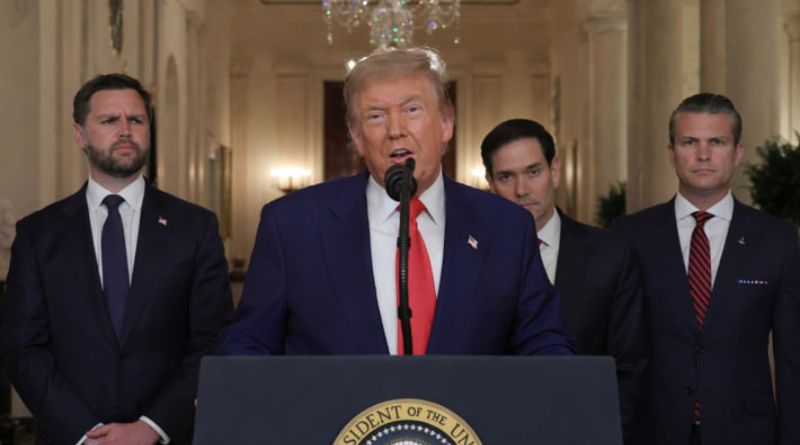
President Donald Trump announced Thursday that the war with Iran was “over” after ordering the cancellation of additional U.S. military strikes against the Islamic Republic, saying Tehran had agreed to abandon any effort to develop nuclear weapons.
“I don’t know if you heard, but we ended the war with Iran today,” Trump said during a tele-rally supporting Georgia Lt. Governor Burt Jones’ campaign for governor.
Trump said the central goal of the conflict was preventing Iran from obtaining a nuclear weapon, claiming that Tehran had agreed to permanent restrictions.
“They have agreed never to have a nuclear weapon, something that we insisted on; that was the whole purpose. That was 95 percent of it,” Trump said.
However, the president said pressure on Iran would continue, with the U.S. naval blockade of the Strait of Hormuz remaining in place until a final agreement is formally signed.
Trump indicated that negotiators could meet in Switzerland to complete the agreement, with reports suggesting a possible signing as early as Sunday ahead of the upcoming G7 summit.
In a statement posted on Truth Social, Trump said he canceled planned strikes after discussions reached Iran’s highest levels of leadership.
“Based on the fact that discussions with the Islamic Republic of Iran have been brought to the highest level of Iranian leadership and approved, I have, as President of the United States of America, cancelled the scheduled strikes and bombings against Iran this evening,” Trump wrote.
He said the framework had been approved by multiple nations, including the United States, Israel, Saudi Arabia, the United Arab Emirates, Qatar, Turkey, Pakistan, Bahrain, Kuwait, Jordan, and Egypt.
“The Naval Blockade will remain in full force and effect until this Transaction is finalized,” Trump added.
Israeli Prime Minister Benjamin Netanyahu’s office later confirmed that Trump had discussed the negotiations with him. Israel said it was not directly involved in the talks but welcomed efforts to ensure any final agreement included strict limits on Iran’s nuclear program and addressed Tehran’s broader regional activities.
The Strait of Hormuz remains a major point of tension. Approximately 25% of the world’s seaborne oil shipments and around 20% of global liquefied natural gas exports pass through the narrow waterway, making it one of the world’s most critical energy routes.
Markets reacted positively to the possibility of a diplomatic breakthrough. European stocks surged Friday, with the Stoxx 600 gaining 1.8% and major indexes rising around 2%.
Oil prices also dropped as investors anticipated reduced risks to global energy supplies. U.S. crude futures declined 1.61%, while Brent crude futures fell 1.75%.
The announcement came days after Trump personally warned Fox News correspondent Trey Yingst about imminent U.S. military action against Iran. Yingst reported that Trump called him from the Situation Room shortly before American forces launched strikes against Iranian military targets.
Trump later said Iran’s military capabilities had been severely damaged, writing on Truth Social that Iran’s military was “a complete and total mess” and claiming much of its naval and air power “doesn’t even exist anymore.”
U.S. Central Command confirmed that additional self-defense strikes began Thursday at 5:15 p.m. Eastern Time against multiple targets inside Iran under the direction of the president.
Now, attention turns to whether the emerging diplomatic framework can hold — and whether the promised nuclear restrictions and security guarantees will lead to a lasting end to the conflict.